Commercial Native Chicken Farming: Managing 50,000+ Birds
Large-Scale Commercial Native Chicken Farming: Managing Flocks of 50,000+ Birds Effectively

Expanding a native chicken farm from a few thousand birds to 50,000 birds is not simply a matter of scaling everything up proportionally. It is a major operational leap that requires a complete change in how the farm is run, from barn design and feed management to disease control and financial planning.
In this article, commercial native chickens are understood in a broad sense: colored-feather chickens or commercial native-cross chickens that grow more slowly than industrial broilers. Depending on the breed, chick source, and farming model, the growing period, FCR, and market weight can vary significantly.
How are commercial native chickens different from industrial broilers, and why is large-scale farming more difficult?
Distinguishing slow-growing colored-feather chickens from fast-growing industrial broilers
Commercial native chickens, colored-feather chickens, or commercial native-cross chickens usually belong to a slower-growing group compared with industrial broilers. While modern industrial broilers can reach around 2.2 kg or more after 35–42 days under good management conditions, native-cross or colored-feather commercial chickens usually need around 10–16 weeks to reach market weight.
Common market weight may be around 1.8–2.2 kg. Some crossbred lines may reach higher weights, while slower-growing local breeds may be lower. Therefore, farmers need to confirm the specific growth characteristics with the chick supplier before planning barn capacity, feed use, and cash flow.
The difference is not only in the growing period. Colored-feather chickens often have firmer meat, yellow skin, yellow legs, and a richer flavor. These are the qualities that make Vietnamese consumers prefer this chicken group for many household meals, restaurants, and mid-range to higher-value food segments.
The FCR of commercial native chickens or colored-feather chickens is usually higher than that of industrial broilers. A reference FCR may be around 2.8–3.5, depending on the breed, market age, farming model, and management conditions. This is a cost disadvantage that needs to be offset by a higher selling price and a more stable market outlet.
The market for colored-feather, yellow-skin chickens in Vietnam: Why demand remains stable despite higher production costs
Colored-feather, yellow-skin, or commercial native-cross chickens in Vietnam continue to see stable demand thanks to consumer habits and traditional food culture. From boiled chicken and salt-steamed chicken to restaurant-style grilled chicken, consumers often prefer chickens with firmer meat, yellow skin, and a richer flavor than white industrial broilers.
Restaurants, industrial kitchens, wet markets, and urban consumer channels remain important outlets. Native chicken prices are usually higher than industrial broiler prices, but the price gap can vary significantly depending on timing, region, and sales channel. Therefore, farmers should not rely on one fixed price. They need to monitor actual local prices and prepare a sales outlet plan before placing chicks.
This creates room for better profit if production costs are tightly controlled. It is also why large-scale native chicken or colored-feather chicken farming is attractive, while at the same time requiring stronger management capability.
Specific challenges when scaling up to 50,000 birds or more
When the flock size exceeds 50,000 birds, three specific challenges become much clearer than in smaller farms.
First, flock health management becomes more complex. High stocking density, large numbers of birds, and movement between pens can increase the risk of disease transmission if biosecurity is not well controlled.
Second, FCR becomes harder to control. Native chickens and colored-feather chickens tend to move more than industrial broilers, expend more energy, and often have a longer growing cycle. If feed quality, barn temperature, humidity, or underlying disease is not controlled, FCR can worsen quickly.
Third, cash flow pressure lasts longer. A 10–16 week production cycle is much longer than the 5–6 week cycle of industrial broilers. This requires farmers to plan working capital more carefully, especially with flocks of 50,000 birds or more.
Barn design and infrastructure for flocks of 50,000+ birds
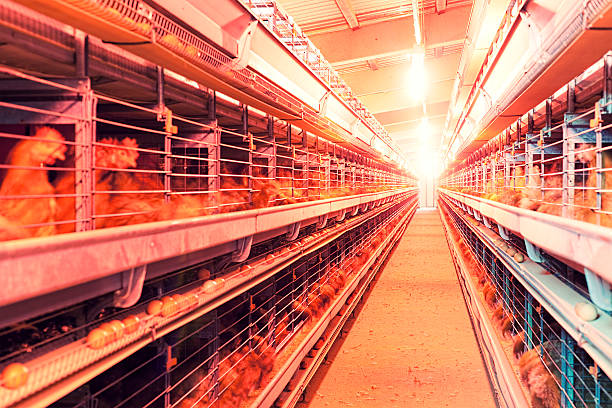
Calculating floor area, stocking density, and barn zoning by growth stage
At the mature stage, a stocking density of 8–10 birds/m² can be used as a reference for commercial native or colored-feather chickens under well-ventilated barn conditions. However, stocking density should not be calculated only by the number of birds per square meter. Farmers also need to consider live weight per square meter, market weight, season, cooling capacity, number of feeders and drinkers, and animal welfare requirements.
At 8–10 birds/m², the direct production floor area needed for 50,000 birds is about 5,000–6,250 m². This figure does not include technical corridors, feed storage, isolation areas, waste treatment areas, and other supporting facilities.
In practice, large-scale farms should divide the flock into multiple smaller pens, with each pen holding about 1,000–2,000 birds, depending on the design. This makes it easier to manage the flock, weigh samples, monitor growth, adjust feed, and localize problems when there are signs of disease.
The farm should be zoned into at least three stages:
- Separate brooding area
- Grow-out area
- Pre-market area
Clear zoning helps reduce cross-contamination risk, optimize stocking density by age, and make sanitation between production cycles easier.
Ventilation, lighting, and automatic nipple drinker systems
Ventilation is critical for large flocks. For closed barns in hot and humid areas, tunnel ventilation combined with exhaust fans, cooling pads, and adjustable curtains is often considered. Fan capacity, air speed, cooling pad area, and negative pressure should be calculated according to the specific barn design, not estimated manually.
Automatic nipple drinkers help reduce water waste, limit wet litter, and save labor. A reference ratio may be around 8–12 birds per nipple, depending on nipple flow rate, bird age, market weight, and the equipment manufacturer’s recommendation.
For a flock of 50,000 birds, the number of nipples may need to be around 4,200–6,250 units, evenly distributed along the main water lines and across each pen. However, the actual number should be calculated based on the barn layout, stocking density, pipe length, and water flow rate.
Lighting should use LED lamps with adjustable intensity. The lighting program should be suitable for each stage to support feeding, reduce stress, and maintain the flock’s natural biological rhythm.
Waste treatment and odor control systems for large-scale farms
With a flock of 50,000 birds, the amount of waste generated each day is very large. The farm needs a suitable process for manure collection, litter management, odor treatment, and wastewater control in line with the farm design and local environmental regulations.
The composting area should be located separately from the production area, preferably downwind if conditions allow, while maintaining a safe distance based on technical advice and the project’s environmental documentation.
Using microbial products for manure treatment and odor reduction can help reduce odor, lower ammonia, and improve barn environmental conditions. However, this measure must be combined with proper ventilation, litter replacement, routine cleaning, and litter moisture management. Microbial products should not be treated as a substitute for proper ventilation design and standard waste treatment.
Stage-by-stage farming process for slow-growing native chickens
Brooding stage, weeks 1–4: Controlling temperature, density, and early mortality
The brooding stage determines much of the flock’s survival rate and later quality. The initial brooding temperature can be around 32–34°C as a reference, then gradually reduced according to bird age, flock behavior, and barn conditions.
Brooding density in the first week can be higher than in the mature stage, but it must be adjusted according to breed, brooder ring design, temperature, number of feeders and drinkers, and the flock’s actual response. If chicks gather tightly under the heat source, they may be too cold. If they move away from the heat source, pant, or lie far from the brooding area, farmers need to check whether the area is too hot or ventilation is not suitable.
In a well-operated farm, mortality in the first four weeks should be kept low, for example below 2–3%. If the rate is higher, farmers need to immediately check chick quality, transport conditions, brooding temperature, drinking water quality, vaccination schedule, and sanitation process.
In particular, chicks from different batches should not be mixed in the same brooding pen unless strict control is in place, because this may increase the risk of cross-infection and uneven flock growth.
Grow-out stage, from week 4 to market: Weekly weight gain and FCR monitoring
From week 4 onward, chickens enter a stronger growth stage. Farmers need to closely monitor three key indicators: average body weight, feed intake, and FCR.
Every week, the farm should weigh a sample of 50–100 birds or take representative samples from each pen or production area, especially when the farm is divided into multiple pens of 1,000–2,000 birds. Farmers should not weigh only a small group in a convenient location, because the data may not accurately reflect the whole flock.
If weekly FCR exceeds the target threshold, the following factors should be checked immediately:
- Feed quality
- Moisture and mold in feed
- Underlying disease status
- Stocking density
- Temperature, humidity, and ventilation
- Flock uniformity
This is also the stage when stocking density needs to be reduced or adjusted at the right time. Keeping birds too crowded after weeks 6–7 can increase feed competition, cause stress, reduce growth, and extend the time needed to reach market weight.
Market weight standards and the right selling time
The Vietnamese market for native or colored-feather chickens often prefers live birds of around 1.8–2.2 kg, depending on the breed and sales channel. Chickens supplied to restaurants, supermarkets, or industrial kitchens usually need higher uniformity, while wet markets may accept a wider weight range.
Farmers need to understand outlet requirements before deciding when to sell. Selling too early may reduce the price because the birds have not reached the desired weight. Keeping them too long can worsen FCR, increase feed costs quickly, and reduce profit margins.
Optimal feed and FCR management for slow-growing commercial native chickens

Feed formulas by stage and actual protein needs
Slow-growing native chickens need a different feed formula from industrial broilers. The brooding stage requires a nutrient-rich ration to support skeletal development, digestive development, and immunity.
A reference nutrition framework is as follows:
| Stage | Reference period | Reference crude protein | Notes |
| Starter | 0–4 weeks | Around 20–22% | Prioritize good digestibility and high-quality ingredients |
| Grower | 4–8 weeks | Around 18–20% | Support stable growth |
| Finisher | From week 8 to market | Around 16–18% | Optimize cost and limit nutrient oversupply |
These levels are for reference only. The actual formula needs to be adjusted according to breed, target weight, available ingredients, feed prices, and advice from a nutrition specialist.
Stable-quality complete feed should be prioritized. Pelleted feed can help reduce selective feeding, limit waste, and make portion control easier. However, pellet quality, pellet durability, and pellet size must be suitable for each age stage.
Target FCR for slow-growing colored-feather chickens and how to measure it weekly
A good target FCR for large-scale commercial native or colored-feather chickens may be around 2.8–3.2, depending on breed and conditions. If FCR exceeds 3.5, this is a sign that the entire process should be reviewed, from feed and environment to flock health.
FCR formula:
FCR = Total feed consumed / Total weight gain
To measure weekly FCR, the farm needs to record:
- Total feed supplied
- Remaining feed, if any
- Average body weight at the beginning and end of the week
- Number of bird losses during the week
- Total flock weight gain
Continuous weekly FCR tracking helps detect problems early before losses accumulate too heavily by the end of the production cycle.
Strategies to reduce feed costs when buying in bulk for a 50,000-bird flock
Feed usually accounts for about 65–70% of total production costs. With a flock of 50,000 birds, weekly feed consumption can reach dozens of tons, creating stronger price negotiation power with suppliers.
Farmers should consider:
- Signing long-term supply contracts to stabilize prices
- Checking the quality of each feed batch
- Avoiding long storage periods during humid seasons
- Maintaining a minimum inventory for 7–10 days of consumption
- Monitoring feed moisture, smell, color, and mold risk
Saving on feed purchase price is important, but farmers should not trade feed quality for lower prices. Poor-quality feed can increase FCR, making actual costs much higher than the initial savings.
Daily management checklist for flocks of 50,000+ birds

Morning flock health check: Signs that need immediate action
Early morning is an important time to detect abnormalities. Managers should walk through each pen and observe:
- Are the birds crowding in one area?
- Are the birds evenly distributed or unusually distributed inside the barn?
- Has the rate of birds refusing feed or water increased compared with the previous day?
- Are there birds showing lethargy, ruffled feathers, breathing difficulty, or abnormal diarrhea?
- Are there unusual dead birds that need immediate inspection?
- Has the ammonia smell in the barn increased?
- Is the litter wet, clumped, or smelly?
Daily mortality data must be recorded by pen. If the mortality rate exceeds the normal threshold or increases suddenly, a veterinarian should be contacted immediately instead of waiting until the next day.
Tracking daily feed intake, water intake, and weight gain
Record the amount of feed distributed and the amount left over each day. A sudden drop in feed intake, for example more than 10% compared with the previous day, is often an early sign of a health problem, weather change, heat stress, or feed quality issue.
Water intake monitoring is equally important. When chickens drink less water than usual, it often comes together with reduced feed intake. On the other hand, unusually high water intake may be related to heat stress, feed quality, or gut health problems.
Daily control of temperature, humidity, and litter condition
For mature chickens, the flock should be kept within the thermal comfort zone, commonly around 18–27°C as a reference, depending on breed, humidity, air speed, stocking density, and bird age. Farmers need to combine thermometer readings with flock behavior, such as panting, crowding, even distribution, frequent lying, or reduced feeding.
Relative humidity may be around 50–70% as a reference. Wet litter creates favorable conditions for ammonia, bacteria, and coccidia to develop. Wet areas must be treated immediately by adding dry litter or replacing the wet layer.
The use of lime or litter treatment products should follow proper technical guidance. Lime should not be spread casually in areas where birds are present without professional advice, because it may irritate the skin, eyes, or respiratory tract.
Disease prevention and large-scale vaccination

Basic vaccination schedule for native chickens from day 1 to market
The vaccination schedule for commercial native chickens needs to be designed according to local disease conditions, maternal antibody levels, chick source, vaccine type, and the vaccine manufacturer’s instructions. The table below is for reference only and does not replace veterinary advice.
| Stage | Reference content |
| Day 1 | Check Marek’s vaccination status from the hatchery. Marek’s vaccine is usually administered at the hatchery by in-ovo vaccination or subcutaneous injection for day-old chicks. Marek’s vaccination should not be incorrectly described as eye-drop or nasal-drop vaccination. |
| Early stage | Newcastle disease and/or IB may be prevented according to a suitable vaccination program, such as eye/nose drops, spray, or drinking water, depending on the vaccine type and veterinary guidance. |
| Weeks 1–2 | Gumboro/IBD should be scheduled based on maternal antibody levels and local disease conditions. |
| Weeks 2–5 | Newcastle disease, IB, or other booster vaccines should be administered according to the veterinary protocol for each farming area. |
| Long growing period | If the growing period is long, farmers should consult a veterinarian to decide whether booster vaccination is needed. |
The specific vaccination schedule should be discussed with local veterinarians or vaccine suppliers to develop the most suitable protocol for each farming area and local disease situation.
Common diseases in high-density colored-feather chicken farming and early detection
Common diseases in high-density native or colored-feather chicken farming include Newcastle disease, Gumboro disease, infectious bronchitis, CRD, and coccidiosis. Among these, coccidiosis has a particularly strong impact on FCR if litter condition, moisture, and drinker hygiene are not well controlled.
Early detection should be based on:
- Changes in droppings, such as unusual color or blood in droppings
- Reduced feed and water intake
- Sudden increase in mortality
- Lethargy, ruffled feathers, or breathing difficulty
- Abnormal flock distribution inside the barn
- Veterinary assessment when suspicious signs appear
When needed, necropsy, sampling, or testing should be carried out according to professional guidance. Farmers should not rely only on visual observation to conclude the disease.
Response process when a disease outbreak is suspected in a 50,000-bird flock
When abnormal signs suggest a possible disease outbreak, the basic principle is to localize the affected area and limit disease spread.
The farm should immediately:
- Isolate the suspected infected pen
- Stop moving people and equipment between pens
- Record mortality rate, symptoms, and time of detection
- Check the latest feed, water, and vaccination records
- Contact a veterinarian for assessment
- Collect samples for testing if instructed
Farmers should not use antibiotics or unknown products without a diagnosis. Incorrect medication can increase costs, mask symptoms, and fail to address the real cause.
Investment cost, operating cost, and realistic break-even point for a 50,000-bird flock

Initial investment items that need to be calculated
Initial investment costs for a 50,000-bird native or colored-feather chicken farm can vary greatly depending on the level of mechanization, location, local material prices, and barn type.
The main items usually include:
| Item | Notes |
| Barn construction | The largest cost item, depending on whether the barn is closed or open-sided, local materials, and technical standards |
| Fans and cooling pad systems | Important for closed barns in hot and humid climates |
| Feeders and nipple drinkers | One-time investment that can be used for multiple cycles if well maintained |
| Electricity and water systems | Need backup options, especially a generator |
| First batch of chicks | Good-quality native or colored-feather chicks usually cost more than white broilers |
| Waste treatment area | Includes composting area, drainage, odor treatment, and litter management |
| Feed and veterinary medicine storage | Should be dry, well ventilated, and protected from insects and pests |
Total initial investment for a 50,000-bird scale, excluding land, may range from several billion to tens of billions of VND depending on the region and level of mechanization. Farmers need to prepare a detailed budget with local technical consultants and refer to actual material prices before making an investment decision.
Operating costs per cycle: feed, veterinary medicine, labor, electricity, and water
For a 50,000-bird native chicken production cycle lasting around 12–16 weeks, operating costs are usually concentrated in the following items. The percentages below are for reference only and may vary by model:
| Item | Reference proportion |
| Feed | Around 65–70% of total operating costs |
| Chicks | Around 10–12% |
| Veterinary medicine and vaccines | Around 5–7% |
| Electricity and water | Around 4–6%, depending on the level of mechanization |
| Labor | Depends on automation level; a well-mechanized farm may need around 3–5 key workers |
FCR and mortality rate are the two variables with the greatest impact on actual cost per cycle. If FCR increases or mortality is high, profit can drop very quickly even when selling prices remain good.
Operational comparison between commercial native chickens and large-scale industrial broilers
| Criteria | Commercial native / colored-feather chickens | Industrial broilers |
| Growing period | Around 10–16 weeks, depending on breed | Around 5–6 weeks |
| Reference FCR | Around 2.8–3.5 | Around 1.6–2.0, depending on conditions |
| Selling price segment | Higher, with less direct price competition | More price-competitive |
| Number of cycles per year | Around 3–4 cycles | Around 6–7 cycles |
| Technical management requirements | High due to longer cycle | More standardized process |
| Working capital pressure | Higher | Lower due to faster turnover |
Native or colored-feather chickens have an advantage in selling price and consumer preference. Their main disadvantages are a longer capital cycle, higher FCR, and stricter technical management requirements.
Illustrative scenario: A 60,000-bird colored-feather chicken farm in southern Vietnam
The scenario below is illustrative and based on common operating models seen in large-scale colored-feather chicken farms. It does not represent a specific business unless an official source or case study is provided.
A 60,000-bird colored-feather chicken farm in southern Vietnam may be divided into multiple production areas, with each area including separate pens for easier management. After the first few production cycles, the farm may draw several important operational lessons.
First, the farm should not cut costs too aggressively on ventilation. In the early stage, if the fan and cooling systems are insufficient, birds are more likely to suffer heat stress, reduce feed intake, show higher FCR, and develop respiratory problems. Investing in a suitable ventilation system from the beginning can help reduce the risk of heat stress, toxic gas buildup, and respiratory disease, thereby supporting better veterinary cost control.
Second, the flock needs to be divided into smaller pens. If too many birds are kept in one large area, abnormalities are detected more slowly and disease localization becomes more difficult. Pens of 1,000–2,000 birds help managers track weight gain, feed intake, mortality, and droppings quality more easily.
Third, FCR must be monitored weekly, not only calculated at the end of the cycle. Many farms only find out that FCR is poor when the flock has already been sold, leaving no chance to adjust. Weekly FCR tracking helps detect feed issues, underlying disease, or barn environment problems early.
Fourth, the outlet plan must be prepared before placing chicks. At a scale of 50,000–60,000 birds, if there are no stable traders, restaurants, industrial kitchens, or distribution channels, the risk of being forced to sell at a low price near market time is very high.
5 common mistakes in large-scale native chicken farming and how to avoid them

1. Expanding scale but still managing the farm like a small operation
Small farms can rely heavily on experience and manual observation. But with 50,000 birds, the farm needs a recording system, pen division, staff assignment, and clear inspection procedures. Without data, it is very difficult to know whether the problem comes from feed, breed, disease, or the environment.
2. Cutting costs in the wrong place: ventilation
Weak ventilation increases ammonia, moisture, heat stress, and respiratory disease. The initial savings may lead to worse FCR and higher veterinary medicine costs. For large flocks, the ventilation system should be calculated from the initial design stage.
3. Not tracking FCR regularly
Many farms only calculate FCR at the end of the cycle, when there is no chance left to make adjustments. Weekly FCR tracking helps detect abnormal changes in feed, flock health, and barn conditions early.
4. No outlet plan before placing chicks
Native chicken prices can fluctuate by season and supply-demand conditions. Having no contract or committed sales channel before placing chicks is a major financial risk for large-scale farms.
5. Ignoring the cleaning period between production cycles
Farms should allow enough downtime for barn emptying, cleaning, and disinfection according to the biosecurity process. Many farms apply around 14–21 days, depending on the production schedule and pathogen pressure. Shortening this period to increase the number of cycles per year may increase disease risk in later cycles.
FAQ about large-scale commercial native chicken farming
How much initial investment is needed to raise a 50,000-bird native chicken flock?
Initial investment costs can vary greatly depending on the region, barn design, level of mechanization, and material prices. The investment may range from several billion to tens of billions of VND, excluding land costs.
The largest items are usually barn construction, ventilation systems, feeders and drinkers, electricity and water systems, the first batch of chicks, and waste treatment areas. Farmers should prepare a detailed budget with local technical consultants and actual quotations before making an investment decision.
What FCR can slow-growing native chickens usually achieve, and how can it be improved?
A good target FCR for large-scale commercial native or colored-feather chickens is usually around 2.8–3.2, depending on breed and conditions. If FCR exceeds 3.5, farmers need to review feed quality, stocking density, temperature, underlying disease, and management processes.
To improve FCR, farmers should prioritize:
- Using stable-quality feed suitable for each stage
- Controlling temperature and ventilation
- Reducing heat stress and excessive stocking density
- Controlling coccidiosis, respiratory disease, and gut health problems
- Weighing samples regularly and tracking FCR every week
How many weeks does it take for commercial native chickens to reach market weight?
Depending on the breed and farming conditions, commercial native or colored-feather chickens usually reach a market weight of around 1.8–2.2 kg live weight after 12–16 weeks. Some faster-growing crossbred lines may reach around 1.8 kg after 10–12 weeks.
Farmers need to confirm the specific growth characteristics with the chick supplier to plan feed, barn capacity, and market outlets properly.
What stocking density is suitable for colored-feather chickens in closed barns?
For native or colored-feather chickens raised in closed barns with good ventilation, mature-stage density can be around 8–10 birds/m² as a reference. However, suitable density should also be calculated based on live weight per square meter, market weight, season, cooling capacity, and number of feeders and drinkers.
Exceeding the suitable density not only affects FCR but also increases disease risk, reduces flock uniformity, and lowers the quality of market-ready birds.
What should be prepared to ensure stable outlets for a large-scale farm?
Farms with 50,000 birds or more need to proactively build sales channels before placing chicks. They can work with large traders, restaurants, industrial kitchens, supermarkets, food chains, or slaughterhouses.
Stable outlets are a key factor in actual profitability, no less important than farming techniques. If the farm depends only on the spot market, it is more likely to face price pressure at market time.
Note
The technical parameters, costs, and ratios in this article are for reference only. Actual conditions may vary depending on region, chicken breed, barn design, season, chick quality, and market prices at the time of farming.
Before investing at a large scale, farmers should consult livestock experts, local veterinarians, barn design providers, and agricultural extension agencies to build a model that fits their actual conditions.
Explore Technical Solutions and Equipment for Large-Scale Poultry Farming at VIETSTOCK 2026
VIETSTOCK 2026 – Vietnam’s Premier International Feed, Livestock & Meat Industry Show – is expected to bring together more than 300 brands and 13,000 trade visitors from many countries, including providers of barn equipment, animal feed, vaccines, poultry breeds, and flock management solutions. This is an opportunity to:
- Gain direct access to providers of ventilation systems, cooling systems, automatic feeders and drinkers, and barn management systems suitable for large-scale poultry farming in Vietnam
- Compare feed and nutrition solutions from multiple suppliers in one place to find the optimal approach for improving FCR and controlling operating costs for large flocks
- Speak with technical experts and breed suppliers about choosing suitable colored-feather chicken lines, managing flocks by stage, and controlling disease effectively
- Connect with buyers, distributors, and slaughterhouses to build stable outlet channels — a critical factor for poultry farms of 50,000 birds or more
Time: October 21–23, 2026
Venue: Saigon Exhibition and Convention Center (SECC), 799 Nguyen Van Linh, Ho Chi Minh City, Vietnam.
Register now to seize opportunities for growth and networking in the livestock industry.
Visitor registration: https://www.vietstock.org/en/online-registration-2/
Event website: https://www.vietstock.org/en/
Contact information:
- Exhibiting: Ms. Sophie Nguyen – [email protected]
- Group Delegation Support: Ms. Phuong – [email protected]
- Marcom Support: Ms. Anita Pham – [email protected]