How to Spray Disinfectants in Livestock Housing: Procedure, Frequency, and Safety Notes
A practical guide to spraying disinfectants in livestock housing, covering mechanical cleaning, correct dilution, spraying techniques, contact time, frequency, ventilation, and worker safety.
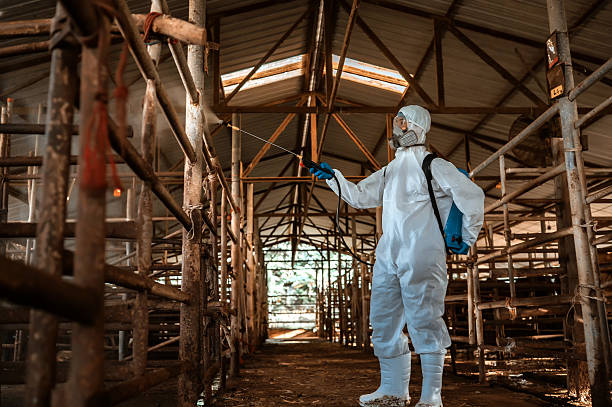
Spraying disinfectants in livestock housing is an important step in a farm biosecurity program. It helps reduce or inactivate pathogens that remain on surfaces after mechanical cleaning. However, disinfection effectiveness does not depend only on the product used. It also depends on surface cleaning, correct dilution, adequate coverage, sufficient contact time, and proper ventilation after treatment.
Carrying out the procedure correctly — from housing preparation, product selection and dilution, spraying technique, to routine frequency — is one of the key factors that directly affects practical disinfection performance.
This article outlines basic practice steps that farmers and farm technicians can refer to when developing a livestock housing disinfection spraying procedure. When selecting products, concentrations, frequency, or response measures for situations with disease risk, users should follow the product label and consult a veterinarian or local veterinary authority.
Key Takeaways
- Mechanical cleaning must be completed before spraying because remaining manure, bedding material, mud, and organic matter can significantly reduce disinfectant effectiveness.
- The right product must be selected and diluted at the correct concentration according to the label. Do not increase the concentration arbitrarily, and do not use a dilution rate intended for empty housing in housing areas where animals are present.
- When spraying, follow a fixed route, move from inside to outside and from top to bottom, ensure surfaces are evenly wetted, and maintain the contact time stated on the product label.
- Disinfection frequency should be adjusted by situation: routine use under normal conditions, after depopulation, before restocking, or intensified during disease events under veterinary guidance.
- Spraying in housing areas where animals are present requires special caution. Only use products allowed by the label, do not spray directly onto animals, and ensure appropriate ventilation.
- Microbial preparations may support livestock housing environmental management under certain conditions, but they should not be treated as substitutes for chemical disinfectants when rapid reduction of pathogen pressure is needed.
- Applicators must wear proper personal protective equipment and handle leftover solution, packaging, and wastewater after disinfection in accordance with regulations.
The Role of Disinfection Spraying in Livestock Housing Biosecurity
What Is Livestock Housing Disinfection and How Is It Different from Mechanical Cleaning?
Mechanical cleaning is the physical removal of organic dirt such as manure, bedding material, leftover feed, mud, and surface biofilms. This step helps reduce dirt and part of the pathogen load in the environment, but it cannot replace disinfection with a suitable product.
Disinfection is the next step. It uses chemicals or products registered for the appropriate purpose to reduce or inactivate bacteria, viruses, fungi, and certain remaining pathogens on surfaces after cleaning.
These two steps complement each other and cannot replace one another. If disinfectant is sprayed onto surfaces still covered with manure, mud, or organic matter, the active ingredient may be neutralized, fail to contact the surface that needs treatment, and lose effectiveness significantly.
In livestock practice, the terms “sanitization” and “disinfection” are sometimes used interchangeably in common language. However, when applied in a technical procedure, users need to follow the definitions, scope of use, and instructions stated on the product label or technical documents.
Why Does Regular Disinfection Spraying Help Control Disease in Pigs, Poultry, and Cattle?
Many pathogens can survive on livestock housing surfaces for several hours to many days or longer, depending on the pathogen, surface material, temperature, humidity, and level of organic matter in the environment.
Routine disinfection spraying may help:
- Interrupt part of the infection cycle.
- Reduce pathogen pressure in the livestock housing environment.
- Limit spread between areas within the farm.
- Reduce the risk of pathogens entering the livestock area from outside.
- Support herd and flock protection during high-risk periods.
- Maintain more stable hygiene conditions between major cleaning events.
However, disinfection spraying is only one link in the overall biosecurity chain. A complete biosecurity program also needs to combine:
- Access control for people.
- Vehicle control.
- Waste management.
- Downtime management.
- Control of animal sourcing.
- Vaccination according to an appropriate program.
- Herd and flock health monitoring.
- Isolation and restocking procedures.
- Vector control.
This article focuses on disinfection spraying techniques. Overall biosecurity plans, downtime procedures, and restocking procedures should be developed separately according to each farm type.
Preparation Before Spraying Disinfectants in Livestock Housing
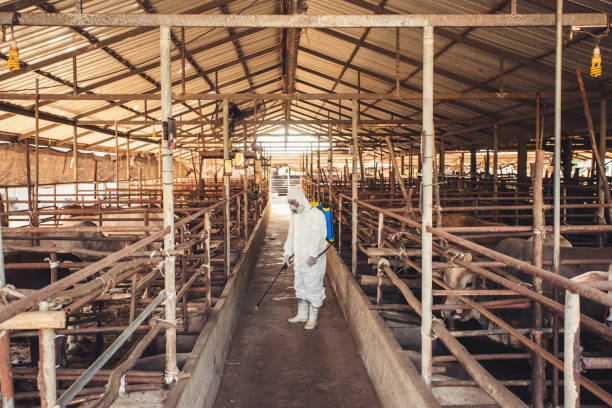
Mechanical Cleaning: Remove Manure, Bedding, and Wash Feeders, Drinkers, and Drainage Channels
Before spraying, the full mechanical cleaning process needs to be completed. This is the foundation that determines the effectiveness of the subsequent disinfection step.
Tasks include:
- Collecting and removing manure from the housing area.
- Removing old bedding material.
- Collecting leftover feed.
- Scrubbing feeders and drinkers with clean water and a suitable brush.
- Cleaning feed trays.
- Clearing drainage channels.
- Removing accumulated mud, waste, and organic matter.
- Washing walls, floors, and hard surfaces if conditions allow.
- Loosening dirt stuck to floors, housing corners, and areas under equipment.
- Allowing surfaces to drain before spraying, unless the product label instructs otherwise.
Only when surfaces are relatively clean can disinfectants contact the treatment area directly and work more effectively. Spraying more product cannot compensate for skipped mechanical cleaning.
Inspect Housing Structure: Surfaces, Cracks, Standing-Water Points, and Easily Missed Areas
Before spraying, the entire housing area should be inspected to identify high-risk areas or locations that are easily missed during treatment.
Areas to check include:
- Wall gaps.
- Floor cracks.
- Junctions between floors and walls.
- Standing-water points.
- Areas that remain damp after washing.
- Hidden corners behind equipment.
- Areas under feeders.
- Areas under cages.
- Areas under floors.
- Wooden or porous surfaces.
- Drainage channels.
- Locations missed during previous spraying rounds.
Standing-water areas should be cleared, dried, or improved for drainage before spraying. If standing water remains, the disinfectant solution may become diluted, fail to maintain adequate contact time, and run out of the treatment area.
Wooden or porous surfaces often absorb solution faster than smooth surfaces, so spraying technique may need to be adjusted according to product instructions. The same amount of solution should not be applied mechanically to every surface type if real conditions differ.
Prepare Spraying Equipment and Personal Protective Equipment
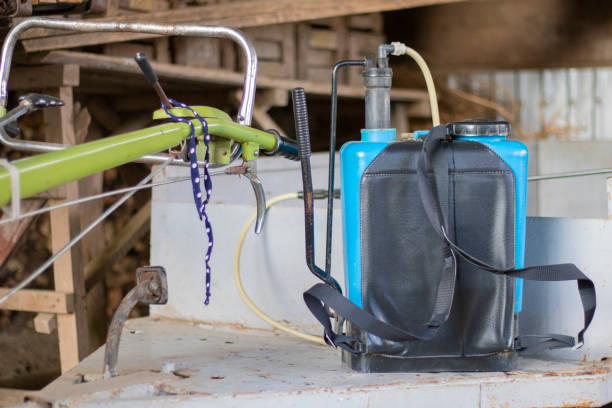
Spraying equipment should be checked before each use to avoid leaks, blocked nozzles, or uneven application.
For hand sprayers or pressure sprayers, check:
- Valves.
- Nozzles.
- Hoses.
- Spray tips.
- Tank.
- Spray pressure.
- Leakage.
- Chemical residue from previous use.
Sprayers should be cleaned before a new product is mixed. Chemical residue should not be left in the tank because it may change effectiveness or cause unwanted reactions when another product is used.
When selecting a nozzle, consider the purpose of use:
- A fine-mist nozzle may be suitable for areas that need light mist coverage, but it should only be used when the product label and ventilation conditions allow it.
- A jet or pressure nozzle may be more suitable for hard surfaces, cracks, or areas that need thorough wetting.
- Excessive pressure should not be used if it causes splashback, excessive runoff, or unnecessary chemical vapor dispersion.
Applicators need to prepare adequate personal protective equipment, especially when using products with strong odors, chemical vapors, or irritation risks.
Protective equipment should include:
- A chemical-filtering mask or respirator suitable for the product.
- Do not use ordinary cloth masks with products that produce toxic vapors or strong chemical odors.
- Sealed safety goggles.
- Thick rubber gloves.
- Protective clothing or disposable rainwear.
- Rubber boots.
- Face shield if there is a risk of splashback.
Arrange Animals and Set Up Ventilation Before Spraying
If animals are present in the housing area, disinfection spraying requires much greater caution than spraying empty housing. Not every product can be used in areas where animals are present.
Spraying should only be carried out when all of the following conditions are met:
- The product label allows use in areas with animals.
- The dilution concentration follows the label instructions.
- The spraying method is recommended by the manufacturer.
- The housing area has appropriate ventilation.
- The product is not sprayed directly onto animals.
- There is a plan to monitor the herd or flock after spraying.
- Applicators have sufficient protective equipment.
In many cases, animals need to be moved out of the spraying area or another suitable treatment method should be used. Extra caution is needed with young animals, stressed herds or flocks, animals with respiratory disease, or poorly ventilated housing.
Ventilation before, during, and after spraying must follow:
- Product label instructions.
- Farm safety procedures.
- Actual housing conditions.
- Recommendations from the veterinarian or technician in charge.
A single fixed ventilation formula should not be applied to every situation because each housing type, animal species, product, and weather condition may require different handling.
Selecting and Diluting Disinfectants for Livestock Housing Spraying
Common Disinfectant Groups Used in Livestock Production
Disinfectant groups commonly used in livestock production have different characteristics, scopes of use, and safety profiles. The table below summarizes general characteristics for reference only. Actual effectiveness depends on product formulation, concentration, contact time, mixing-water quality, level of organic matter, surface type, and target pathogen.
| Active ingredient group | Main advantages | Limitations to note |
| Chlorine compounds | Relatively broad spectrum, low cost, fast action under suitable conditions | Effectiveness can be reduced by high organic matter, may corrode metals at high concentrations, must not be mixed with acids or ammonia |
| Iodophors | Relatively broad spectrum against many bacteria, viruses, and fungi when used under appropriate conditions | May be affected by pH, organic matter, and product formulation; may leave stains on surfaces |
| Quaternary ammonium compounds (QACs) | Low odor, less corrosive, relatively easy to use in some routine hygiene programs | Usually less effective against spores and many non-enveloped viruses; easily affected by soap, anionic detergents, and organic matter |
| Glutaraldehyde and aldehyde products | May have high efficacy against many bacteria, viruses, and fungi under suitable conditions | Higher toxicity, requires sufficient contact time, strict ventilation, and protective equipment; activity against spores depends on the product label |
| Peroxygen compounds or strong oxidizers | Broad spectrum under many conditions of use, often used in high-efficacy programs | Higher cost, may be corrosive at high concentrations, must be stored and used according to instructions |
Note: Lime and microbial preparations may support livestock housing environmental management under certain conditions, but they should not be placed on the same level as chemical disinfectants used for spraying. Lime is often more suitable for treating floors, pathways, or surrounding areas. Microbial preparations may support odor, waste, or environmental management, but they do not replace disinfectants when rapid reduction of pathogen pressure is required.
A detailed comparison of each group by pathogen type and housing condition should be presented in a separate in-depth article on livestock housing disinfectant groups.
Criteria for Selecting Products by Animal Species, Target Pathogen, and Housing Conditions
When selecting a disinfectant product, farmers should not rely only on cost or advertising. Multiple factors need to be considered to ensure that the product suits real farm conditions.
Key criteria include:
- Target pathogen: Lipid-enveloped viruses are often more sensitive to many active ingredient groups than non-enveloped viruses. For highly resistant pathogens, products with suitable efficacy claims on the label should be prioritized.
- Animal species: Each species may have different sensitivity to chemicals, vapors, and spraying conditions.
- Production stage: Young poultry, piglets, calves, or weakened animals are often more sensitive to chemical vapors, moisture, and high concentrations.
- Housing status: Empty housing usually allows more active ingredient groups to be used than housing areas where animals are present.
- Surface conditions: Surfaces with high organic matter, porous surfaces, or surfaces with many cracks need suitable products and spraying techniques.
- Corrosion risk: This is important for housing with many metal devices, troughs, grids, fans, or pipes.
- Ventilation conditions: Enclosed housing requires greater caution when using products with strong odors or chemical vapors.
- Legal compliance: Priority should be given to products legally registered for circulation in Vietnam, with clear labels and Vietnamese instructions for use.
Always consult a veterinarian, the technician in charge, or a qualified supplier when selecting a product for a specific disease-risk situation.
How to Dilute Products Correctly: Dilution Ratio, Water Source, and Label Check
Correct dilution is essential for effective disinfection and for reducing risks to people, animals, equipment, and the environment.
Dilution principles include:
- Read the product label carefully before mixing.
- Check the expiry date.
- Check storage conditions.
- Use clean water.
- Use water with suitable pH if required by the product.
- Do not use water with excessive sediment or organic matter.
- Dilute according to the ratio recommended on the label.
- Do not increase the concentration with the assumption that “stronger is more effective”.
- Use measuring cups, measuring cylinders, or dosing equipment.
- Do not estimate by eye.
- Mix only the amount needed for the day.
- Do not store diluted solution for several days unless the manufacturer allows it.
- Do not mix multiple products together unless there is specific guidance.
If the water source is unstable, has high sediment, abnormal pH, or high hardness, ask the product supplier about water-quality requirements before use.
An excessively high concentration may cause:
- Respiratory irritation.
- Skin and eye irritation.
- Stress in animals.
- Equipment corrosion.
- Chemical waste.
- Increased residue risk.
- Higher risk for applicators.
Conversely, a concentration that is too low may prevent the product from achieving the required effectiveness, especially when surfaces have not been cleaned thoroughly or the target pathogen is highly resistant.
Concentration Limits When Spraying in Housing Areas With Animals
When animals are present, only use products that meet all of the following conditions:
- The product label allows use in areas with animals.
- A concentration or dilution rate is provided specifically for use when animals are present.
- The spraying method is recommended by the manufacturer.
- Instructions are provided for contact time, ventilation, and safe re-entry or isolation time if needed.
- The product is suitable for the animal species, age, and health status of the herd or flock.
Do not use the dilution rate intended for empty housing when spraying in areas where animals are present. Some products containing glutaraldehyde, phenolics, high-concentration chlorine, or other strong active ingredients may not be suitable for direct spraying when animals are present.
If it is unclear whether a product can be used in occupied housing, check the label and consult a veterinarian before making a decision.
Correct Techniques for Spraying Disinfectants in Livestock Housing
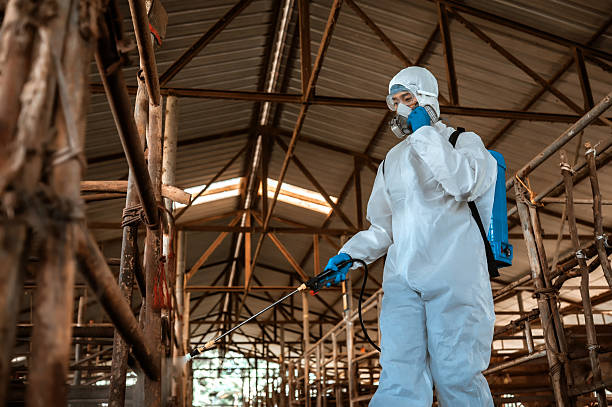
Spraying Route: From Inside to Outside, From Top to Bottom, and in a Zigzag Pattern
A fixed route should be used during spraying to avoid missing areas and to reduce the need to step back into treated zones.
Spraying route principles include:
- Start from the innermost part of the housing area.
- Move gradually toward the entrance.
- Avoid stepping back into treated areas.
- Limit carrying pathogens from outside areas into treated areas.
- Spray from top to bottom.
- Spray ceilings and beams first.
- Then spray walls.
- Finally spray floors and drainage channels.
- Move in a zigzag or even sweeping pattern.
- Do not miss narrow strips between spray passes.
The spraying route should be standardized into a checklist for each housing area, especially on farms with multiple housing rows, multi-tier cage systems, or several support areas.
Spraying Techniques for Each Surface: Walls, Ceilings, Floors, Drainage Channels, Hidden Corners, and Farm Tools
Walls and Ceilings
When spraying walls and ceilings, keep the nozzle at a distance suitable for the nozzle type, pressure, and equipment instructions. The goal is to create an even layer of solution on the surface, not to spray so strongly that the solution splashes back or runs off in streams.
Pay attention to:
- Cracks.
- Gaps.
- Beams.
- Underside of the roof.
- Junctions between walls and ceilings.
- Areas behind hanging equipment.
Floors
Floors are exposed to waste, wash water, spilled feed, and pathogens. When spraying floors, ensure that surfaces are evenly wetted.
Pay attention to:
- Junctions between floors and walls.
- Housing corners.
- Areas under feeders.
- Areas under drinkers.
- Floor cracks.
- Areas that were previously damp or had standing water.
Porous, rough, or fast-absorbing surfaces may require adjustment of solution volume according to the product label and actual conditions.
Drainage Channels
Drainage channels should only be treated after they have been cleaned and wastewater is under control. Do not spray when drains are still full of mud, manure, or uncontrolled flow.
When treating drainage channels:
- Remove waste, mud, and organic matter first.
- Wet the drainage surface adequately according to the product label.
- Avoid allowing excess solution to flow directly into ponds, canals, ditches, or domestic water sources.
- Manage wastewater after treatment according to farm and local regulations.
Hidden Corners and Areas Under Equipment
Hidden corners are among the easiest areas to miss during spraying. They also often retain moisture, dust, manure, organic matter, and pathogens.
Use a long nozzle or adjust the spray angle to reach:
- Areas under feeders.
- Back sides of equipment.
- Areas under cages.
- Areas under floors.
- Wall corners.
- Column bases.
- Cracks and joints.
After spraying, these points should be checked again before the procedure is completed.
Farm Tools
Farm tools such as shovels, brooms, carts, feed trays, cleaning tools, and small equipment may carry pathogens from one area to another.
Actions include:
- Clean tools before spraying or soaking in disinfectant.
- Spray all surfaces evenly.
- Pay attention to undersides, joints, and handles.
- Treat feeders and drinkers separately.
- Rinse with clean water after the contact time if the label requires it.
- Do not return tools to use if they still have a strong chemical odor or have not met safe-use conditions stated on the label.
Solution Volume per Square Meter and How to Recognize Adequate Surface Wetting
The amount of solution required depends on:
- Product label.
- Surface type.
- Spraying method.
- Surface roughness.
- Absorption level.
- Temperature.
- Humidity.
- Surface cleanliness.
A single general application rate should not be applied to every situation. Porous or rough surfaces usually require a different amount of solution than smooth surfaces. Farms should refer to the product label or supplier to determine the suitable solution volume.
Signs that a surface has received enough solution include:
- The surface is evenly wet.
- A thin layer of solution covers the surface.
- No dry areas remain.
- No areas are only slightly damp.
- The solution does not run off excessively in streams.
If the solution immediately runs off in streams, too much may be applied, causing waste and increasing the risk of chemical-containing wastewater. If the surface is only slightly damp or many dry areas remain, spraying technique or solution volume should be adjusted.
Contact Time, Drying, and When Rinsing Is Needed After Spraying
Contact time is the period during which the product needs to remain on the surface to reduce or inactivate pathogens according to product claims. This time must follow the product label and may vary depending on:
- Active ingredient group.
- Pathogen type.
- Surface type.
- Temperature.
- Humidity.
- Surface cleanliness.
- Product formulation.
Low temperature, dirty surfaces, or insufficient contact time may reduce the effectiveness of many disinfectant products.
After the contact time is complete, the next handling step should be based on the product label and the area treated.
For empty housing:
- Surfaces may be allowed to dry naturally if the label allows it.
- Ventilation should be increased.
- Animals should not be introduced if there is still a strong chemical odor, the floor is too wet, or the required waiting period has not been completed according to the instructions.
- Whether rinsing is required must follow the product label; it should not be assumed to be the same for every product.
For feeders, drinkers, and surfaces that directly contact feed or drinking water:
- Rinse with clean water after the contact time if the label requires it.
- Pay special attention to chemical residue risks.
- Allow surfaces to dry before use.
- Do not allow animals to contact tools that still have a strong chemical odor or standing solution.
For housing areas where animals are present:
- Increase ventilation after spraying.
- Monitor the herd or flock.
- Do not allow animals to contact surfaces with excessive standing solution.
- Follow safe-use time stated on the product label, if any.
Notes When Spraying in Housing Areas Where Animals Are Present
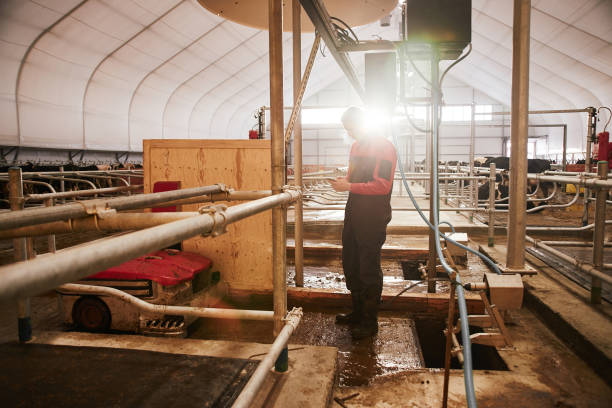
Spraying disinfectants in occupied housing requires much greater caution than spraying empty housing. Only use products whose label allows use in areas with animals, at the correct concentration, by the correct spraying method, and under suitable ventilation conditions.
Key points include:
- Choose a cool time of day if conditions allow.
- Do not spray directly into animals’ face, eyes, nose, mouth, or respiratory tract.
- Do not make animals excessively wet, especially young animals, weak animals, stressed herds or flocks, or animals kept in poorly ventilated housing.
- Use fine-mist nozzles only if the product label and ventilation conditions allow it.
- Do not use an overly strong spray jet.
- Do not use the dilution rate intended for empty housing in occupied housing.
- Monitor animals after spraying according to the product label and actual farm conditions.
In the first few hours after spraying, pay special attention to signs of respiratory, eye, or skin irritation, or abnormal behavior.
If animals show any of the following signs, increase ventilation immediately and contact a veterinarian:
- Difficulty breathing.
- Watery eyes.
- Coughing.
- Sneezing.
- Loss of appetite.
- Abnormal clustering.
- Agitation.
- Lying down more than usual.
- Signs of skin irritation.
Disinfection Frequency by Situation
Routine Frequency Under Normal Conditions
Spraying frequency should be developed according to each farm’s biosecurity plan. A fixed schedule should not be applied to every facility.
Factors that affect frequency include:
- Animal species.
- Stocking density.
- Housing type.
- Local disease situation.
- Level of movement of people and vehicles.
- Weather conditions.
- Disease history.
- Actual hygiene status.
- Guidance from the veterinarian in charge of the farm.
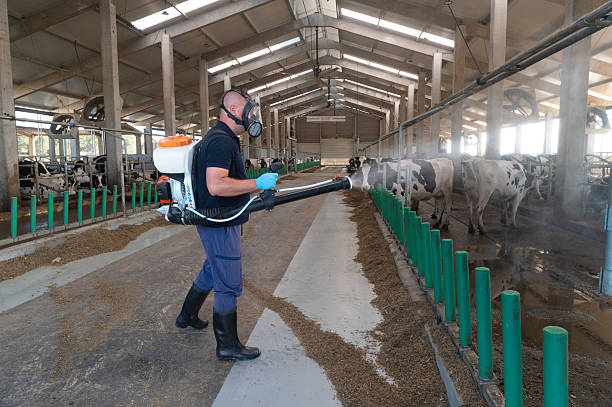
Under normal conditions, some farms may spray disinfectants weekly or apply more frequent controls at high-risk points such as gates, main pathways, manure-handling areas, isolation areas, and vehicle areas.
Areas with high traffic usually need to be checked and cleaned more frequently than areas used less often. However, specific frequency should be adjusted according to guidance from the farm veterinarian and local veterinary authority.
Frequency and Concentration During Disease Events in the Herd or Nearby Area
When disease is detected in the herd or in nearby areas, farms need to strengthen disinfection at high-risk points under professional guidance. Farms should not independently set very frequent spraying schedules, increase concentrations, or expand treatment scope without appropriate guidance for the specific pathogen.
Areas that often need priority control include:
- Entrance gates.
- Main pathways.
- Isolation areas.
- Sick-animal handling areas.
- Waste collection areas.
- Vehicle access areas.
- Shared tools.
- Areas between housing rows.
When disease is present or suspected:
- Follow guidance from the veterinary authority or the veterinarian in charge.
- Do not increase concentration beyond the label rate.
- Do not mix multiple products together.
- Strengthen control of people and vehicles.
- Maintain intensified measures until the risk is considered resolved by professional assessment.
- Keep full records of implementation.
The disinfection log should record:
- Date.
- Time.
- Area sprayed.
- Product name.
- Active ingredient group.
- Concentration.
- Solution volume.
- Applicator.
- Herd or flock condition after spraying.
- Previous and next disinfection schedule.
Disinfection Schedule Before and After Each Production Cycle, During Downtime, and Before Restocking
The transition between production cycles is an important time for more thorough cleaning and disinfection compared with the production period.
After depopulation:
- Remove all manure and bedding.
- Carry out mechanical cleaning.
- Wash the housing area.
- Allow surfaces to drain.
- Disinfect according to the farm procedure.
- Apply additional treatment if technical guidance requires it.
During downtime:
- Keep housing dry and well ventilated.
- Limit access by people and vehicles.
- Monitor hygiene conditions.
- Retreat high-risk areas if needed.
- Check feeders, fans, grids, floors, and drainage systems.
Before restocking:
- Inspect the entire housing area.
- Carry out the final disinfection spray if the procedure requires it.
- Allow housing to dry and ventilate.
- Check the source of incoming animals.
- Prepare the isolation area.
- Ensure feeders and drinkers are clean.
- Ensure the ventilation system works properly.
The number of sprays, interval between applications, downtime duration, and active ingredient rotation should follow the product label, farm conditions, and veterinary advice.
Adjusting Frequency by Disease Season and Stocking Density
Disinfection frequency should not remain fixed throughout the year. Farms need to adjust frequency according to season, humidity, stocking density, and actual disease risk.
Factors to note include:
- Cold and humid weather: Some respiratory and digestive pathogens may survive longer in the environment. Cleaning and disinfection should be strengthened according to actual risk.
- Hot season: Some products may evaporate faster or surfaces may dry too quickly. Spraying time should be selected appropriately, often early morning or late afternoon if conditions allow.
- High humidity: Surfaces dry more slowly and the effectiveness of some products may be affected.
- High stocking density: Pathogen pressure is usually higher, so more attention should be paid to cleaning, ventilation, and access control.
- Rainy season: Outdoor areas, farm pathways, gates, and vehicle areas require attention because solution may be washed away or diluted.
Safety for Farmers and the Environment
Health Risks from Repeated Exposure to Disinfectants
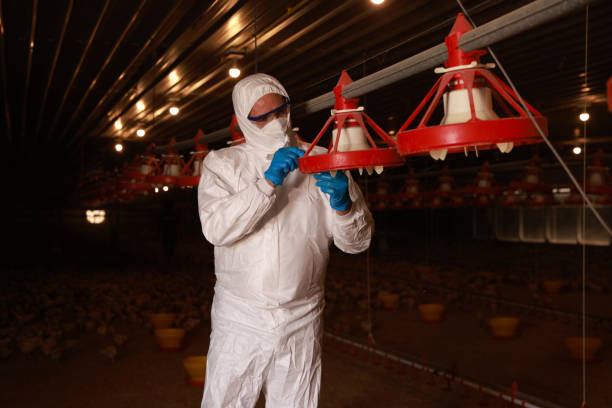
Repeated exposure to disinfectant chemicals, especially glutaraldehyde, high-concentration chlorine compounds, phenolics, or strong oxidizers, may create risks for applicators if proper protection is not used.
Possible symptoms include:
- Respiratory irritation.
- Skin irritation.
- Eye irritation.
- Coughing.
- Sore throat.
- Difficulty breathing.
- Contact dermatitis.
- Chemical sensitization after long-term exposure.
People who spray frequently should:
- Never skip protective equipment, even for short spraying sessions.
- Check filter masks before use.
- Replace gloves if torn.
- Replace protective equipment periodically.
- Avoid eating or drinking in the mixing area.
- Avoid smoking while mixing or spraying chemicals.
- Avoid touching the face while spraying.
- Rinse immediately if chemicals splash onto the skin or into the eyes.
If prolonged irritation symptoms occur:
- Stop exposure.
- Leave the spraying area.
- Rinse the affected area with clean water.
- See a doctor if symptoms do not improve.
- Consider changing the product, improving ventilation, or adjusting the protective procedure.
Personal Procedure After Spraying: Removing Protective Gear, Showering, and Handling Protective Clothing
After spraying is completed, protective equipment should be removed properly to avoid chemicals contacting the skin, eyes, or inner clothing.
Protective equipment may be removed in the following order:
- Boots.
- Protective clothing.
- Gloves.
- Goggles.
- Mask or respirator.
During removal, avoid touching the face, eyes, nose, or mouth.
Afterward, applicators should:
- Wash hands with soap.
- Wash the face.
- Shower thoroughly.
- Change clothes.
- Wash reusable protective clothing separately.
- Place disposable clothing in a sealed bag.
- Avoid bringing dirty protective gear into living areas.
- Avoid washing protective clothing together with everyday clothing.
Handling Leftover Solution, Packaging, and Wastewater After Disinfection
Leftover diluted solution, packaging, and wastewater after disinfection should be handled carefully to reduce risks to the environment, water sources, and workers.
Key points include:
- Do not discharge leftover diluted solution directly into ponds, canals, ditches, or domestic water sources.
- Do not pour chemicals into wells or areas near water sources.
- Collect wastewater into the farm’s treatment system if available.
- Collect bottles and packaging separately.
- Do not reuse chemical containers for water, feed, or household items.
- Do not burn or bury packaging arbitrarily.
- Handle materials according to product label instructions and local regulations.
- Consult veterinary or environmental authorities if the disposal method is unclear.
Common Mistakes When Spraying Disinfectants in Livestock Housing and How to Fix Them
Skipping Mechanical Cleaning Before Spraying
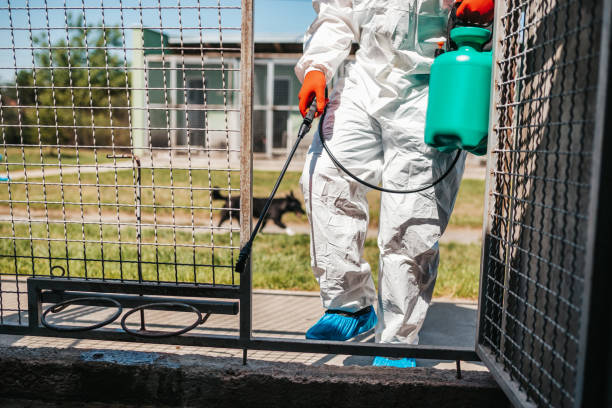
This is the most common mistake and has the greatest impact on disinfection effectiveness. Organic matter on surfaces can neutralize active ingredients or prevent the product from directly contacting the area that needs treatment.
How to fix it:
- Always remove manure.
- Remove bedding material.
- Wash surfaces.
- Clean feeders, drinkers, and drainage channels.
- Allow surfaces to drain before spraying if the product label does not instruct otherwise.
Incorrect Dilution or Using the Wrong Product for the Target Pathogen
A solution that is too weak may not be effective. A solution that is too concentrated may cause waste, increase toxicity, irritate animals, and increase equipment corrosion risk.
Using the wrong active ingredient also reduces effectiveness. For example, some QAC products have limited efficacy against many non-enveloped viruses or spores, depending on product formulation and label claims.
How to fix it:
- Read the label carefully.
- Use measuring tools.
- Identify the target pathogen.
- Do not increase concentration arbitrarily.
- Do not use products outside their label scope.
- Consult a veterinarian when unsure.
Missing Hidden Corners, Insufficient Surface Wetting, or Spraying in the Wrong Direction
Spraying from outside to inside may increase the risk of carrying pathogens from dirty areas into treated areas. Missing hidden corners creates “blind spots” where pathogens may survive and cause recontamination.
How to fix it:
- Establish a fixed spraying route.
- Start from inside and move outside.
- Spray from top to bottom.
- Mark areas that are easy to miss.
- Recheck after spraying.
- Apply additional spraying if dry areas remain.
- Train applicators using the farm checklist.
Spraying Under Unsuitable Weather Conditions
Weather conditions can affect spraying effectiveness, especially for outdoor areas or naturally ventilated housing.
Rain may:
- Dilute the solution.
- Wash away the product.
- Reduce contact time.
Strong sunlight may:
- Cause products to evaporate quickly.
- Shorten contact time.
- Increase heat stress risk if animals are present.
Very high humidity may:
- Slow drying.
- Affect certain active ingredient groups.
- Increase the risk of standing solution in some areas.
How to fix it:
- Spray in the early morning or late afternoon if conditions allow.
- Avoid spraying when it is raining.
- Do not spray outdoor areas right before rain.
- Check the weather forecast for pathways, farm gates, and outdoor yards.
- Adjust ventilation after spraying based on actual conditions.
Using One Product for Too Long Without Evaluating Effectiveness
Repeated use of one active ingredient over a long period without evaluating performance may make the disinfection program less suitable, especially when the target pathogen, organic matter load, cleaning procedure, or housing conditions have changed.
However, active ingredient rotation should not be done arbitrarily. It should be based on technical reasoning and professional advice.
Evaluation should consider:
- Target pathogen.
- Farm conditions.
- Product compatibility.
- Disease history.
- Hygiene results after spraying.
- Technical plan.
- Veterinary advice.
Practical Checklist for Livestock Housing Disinfection Spraying
Before Spraying: Housing, Equipment, Product, Protective Gear, and Animal Arrangement
- Mechanical cleaning has been completed: manure and bedding removed, feeders scrubbed, and drainage channels cleared.
- Hidden corners, gaps, and standing-water points have been checked and marked.
- Valves, nozzles, hoses, and spray tips have been checked.
- Old chemical residue has been cleaned from the tank.
- The correct product has been selected.
- The expiry date has been checked.
- The label has been read carefully.
- The product has been diluted at the correct concentration using measuring tools.
- Suitable clean water has been used.
- Full protective gear is worn: mask or respirator, goggles, gloves, protective clothing, and boots.
- Animals have been arranged according to requirements.
- Ventilation has been set up according to the product label and actual conditions.
During Spraying: Route, Required Areas, Solution Volume, and Contact Time
- Start from the innermost area and move toward the entrance.
- Spray from top to bottom: ceiling → walls → floor → drainage channels.
- Spray evenly in a zigzag pattern.
- Do not miss hidden corners or areas under equipment.
- Ensure surfaces are evenly wet.
- Do not leave dry areas.
- Do not spray so much that the solution runs off in streams.
- Maintain the contact time stated on the product label.
- Do not spray directly onto animals.
- Do not stand against the wind or airflow carrying chemical vapors.
After Spraying: Ventilation, Inspection, Records, and Herd Monitoring
- Increase ventilation after spraying.
- Recheck easily missed areas.
- Spray again if dry areas remain.
- Do not introduce animals if housing has not met safe-use conditions stated on the label.
- Remove protective equipment in the correct order.
- Wash hands, shower, and change clothes.
- Record date, time, product, concentration, area treated, and applicator.
- Handle leftover solution according to regulations.
- Collect packaging.
- Monitor the herd or flock after spraying if animals are present, especially during the first few hours.
Frequently Asked Questions About Spraying Disinfectants in Livestock Housing
Does livestock housing need to be rinsed after disinfectant spraying?
It should not be assumed that rinsing is always required or never required after spraying. Whether rinsing is needed depends on the product label, surface type, area of use, residue risk, and timing for animals to return.
For feeders, drinkers, tools that directly contact feed or water, or surfaces that animals may lick, bite, or contact directly, rinse with clean water if the label requires it or if there is a chemical residue risk.
For floors, walls, ceilings, and empty housing surfaces, they may be allowed to dry naturally if the product label allows it. Before animals return, make sure the housing is well ventilated, surfaces are relatively dry, and there is no strong chemical odor.
What should be noted when spraying disinfectants in housing areas where animals are present to avoid poisoning?
Spraying should only be carried out in areas with animals when the product label allows it and provides clear guidance on concentration, spraying method, ventilation, and safe-use time.
Key points include:
- Only use products allowed by the label.
- Use the correct concentration intended for occupied housing.
- Choose a cool time of day if conditions allow.
- Ensure proper ventilation.
- Do not spray directly into animals’ face, eyes, nose, mouth, or respiratory tract.
- Do not spray so much that animals become excessively wet.
- Do not use the dilution rate intended for empty housing.
- Monitor animals after spraying.
- Increase ventilation immediately if abnormal signs appear.
- Contact a veterinarian if animals show difficulty breathing, watery eyes, coughing, loss of appetite, or signs of irritation.
What spraying frequency should be used during a disease event and after the disease is controlled?
When disease is present or suspected, disinfection at high-risk areas should be intensified under guidance from the veterinary authority or the veterinarian in charge. Farms should not independently set a schedule of one to two sprays per day, increase concentrations, or expand the treatment scope without professional guidance for the specific pathogen.
After the disease is controlled, the farm still needs to maintain intensified measures until the risk is considered resolved by a veterinarian and competent authority. The schedule can then be gradually adjusted back to routine frequency.
Frequency should not be reduced simply because no new cases have been observed. Adjustments should be based on the disease situation, herd or flock health, environmental hygiene, and professional recommendations.
Does using the same disinfectant long term reduce effectiveness, and is active ingredient rotation needed?
Repeated use of one active ingredient over a long period without evaluating effectiveness may make the disinfection program less suitable in some cases. This may result from changes in the target pathogen, remaining organic matter, incorrect dilution, insufficient contact time, biofilm, or changing housing conditions.
Active ingredient rotation may be considered, but it should:
- Be based on technical reasoning.
- Identify the target pathogen.
- Check product compatibility.
- Evaluate housing conditions.
- Involve veterinary consultation.
- Avoid mixing products unless clear guidance is available.
Active ingredient rotation does not replace mechanical cleaning, correct dilution, and adequate contact time.
After spraying empty housing, how long should the farm wait before restocking?
There is no fixed waiting time that applies to every farm. Downtime depends on animal species, disease pressure, active ingredient group, ventilation conditions, moisture, housing dryness, and veterinary guidance.
Before restocking, make sure:
- Housing is relatively dry or meets the farm procedure.
- There is no strong chemical odor.
- Feeders and drinkers have been cleaned.
- The ventilation system works normally.
- The source of incoming animals has been checked.
- The isolation area is ready.
- The biosecurity procedure is fully prepared.
If the previous herd or flock had an infectious disease or the area is under disease risk, consult a veterinarian or local veterinary authority before restocking.
Standardize Livestock-Housing Disinfection at VIETSTOCK 2026
Effective disinfection requires control at every stage, from mechanical cleaning and chemical dilution to spraying coverage, contact time, ventilation, worker protection, and post-treatment records. On larger farms or facilities with several housing blocks, inconsistent manual practices can lead to missed surfaces, excessive chemical use, and difficulty evaluating whether the procedure has been completed correctly.
At VIETSTOCK 2026, livestock producers, farm managers, veterinary professionals, animal-health companies, and equipment providers can explore technologies that support safer and more consistent disinfection operations.
Visitors can:
- Compare hand sprayers, pressure sprayers, mobile spraying units, and automated systems for different farm scales.
- Explore dosing and mixing technologies that help control concentration and solution volume.
- Discover equipment designed to reach ceilings, cracks, drainage channels, areas under cages, and other difficult surfaces.
- Access personal protective equipment, ventilation-monitoring devices, and chemical-safety solutions.
- Review software and digital tools for scheduling, recording, and evaluating cleaning and disinfection activities.
- Connect with animal-health companies, equipment suppliers, and biosecurity specialists.
Expected to feature more than 300 brands, over 10,000 sqm of exhibition space, and 13,000 trade visitors from more than 40 countries and territories, VIETSTOCK 2026 creates opportunities for farms and businesses to compare technologies and strengthen operational consistency across the livestock and animal-health value chain.
Alongside the exhibition and business-networking activities, VIETSTOCK 2026 will also organize an On-Farm Seminar Series, bringing practical knowledge on herd and flock management, disease prevention, biosecurity, and livestock-production efficiency to key livestock regions.
Date: 21–23 October 2026
Venue: Saigon Exhibition and Convention Center – SECC, 799 Nguyen Van Linh Street, Tan My Ward, Ho Chi Minh City, Vietnam
Event website: https://www.vietstock.org/en/
👉 Register to visit VIETSTOCK 2026 and explore spraying, dosing, monitoring, and farm-biosecurity technologies:
https://www.vietstock.org/en/online-registration-2/
👉 Learn more about the VIETSTOCK 2026 On-Farm Seminar Series:
https://www.vietstock.org/en/event-features/vietstock-2026-livestock-roadshows-bringing-industry-knowledge-to-key-livestock-regions/
CONTACT INFORMATION:
Exhibiting: Ms. Sophie Nguyen – [email protected]
Visitor Support: Ms. Phuong – [email protected]
Marcom Support: Ms. Anita Pham – [email protected]