Using Lime Powder for Livestock Housing Disinfection: Application Methods, Timing, and Common Mistakes
Learn how to use lime powder safely for livestock housing disinfection, including surface preparation, application timing, suitable areas, safety precautions and common mistakes to avoid.
Lime powder is widely used in livestock production to support the treatment of floors, pathways, drainage areas, damp zones, waste-handling points, and areas surrounding animal housing.
When applied to a cleaned surface under suitable conditions, lime can help:
- Increase surface alkalinity;
- Dry selected damp areas;
- Improve environmental hygiene;
- Reduce odour under appropriate management conditions;
- Make the treated surface less favourable for certain microorganisms.
However, lime should not be treated as a universal disinfectant.
Its performance depends on:
- The type of lime;
- Surface moisture;
- Remaining manure and organic matter;
- Application thickness;
- Ventilation;
- Surface material;
- Contact conditions;
- Animal exposure;
- The purpose of treatment.
Lime is most useful as a supporting environmental-hygiene measure. It does not replace mechanical cleaning, specialized disinfectants, vaccination, waste management, access control, or veterinary disease-control measures.
Professional and Safety Note
This article provides general practical guidance and does not replace product labels, farm biosecurity procedures, veterinary advice, or instructions from the competent animal-health authority.
When a serious infectious disease is suspected or confirmed, farms should follow the applicable disease-control guidance instead of relying only on routine lime application.
Extra caution is required when using quicklime because it can react with water, release heat, and cause irritation or burns.
Key Takeaways
- “Lime powder” may refer to quicklime containing calcium oxide or hydrated lime containing calcium hydroxide. The two materials should not be treated as identical.
- Manure, bedding, feed residues, mud, and standing water should be removed before lime is applied.
- Lime should generally be spread in a thin, even layer rather than piled in concentrated areas.
- Quicklime should not be poured directly into standing water because the reaction can release heat and increase safety risks.
- Lime dust may irritate the eyes, skin, respiratory tract, and feet of animals.
- Direct application inside occupied housing should be approached cautiously.
- Lime is commonly more suitable for empty housing, external pathways, drainage surroundings, waste areas, and other locations without direct animal contact.
- A thick layer does not necessarily provide better control and may create more dust, waste, and exposure.
- Lime should not be mixed arbitrarily with disinfectants or added to the same footbath or spray solution.
- The effectiveness of lime should be assessed as part of the farm’s full cleaning and biosecurity program.
1. Start by Identifying the Type of Lime
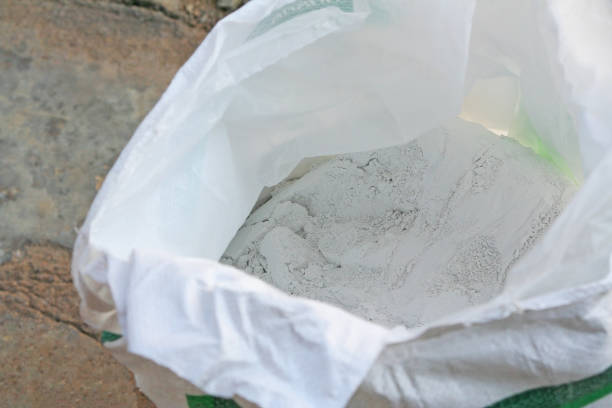
Before using a product, the farm should check the label, composition, supplier information, and safety instructions.
The term “lime powder” may refer to different materials.
1.1 Quicklime
Quicklime mainly contains calcium oxide, commonly written as CaO.
When it contacts water or moisture, it can react to form calcium hydroxide and release heat.
This reaction means quicklime requires careful handling around:
- Wet floors;
- Standing water;
- Drainage channels;
- Skin;
- Eyes;
- Animals;
- Flammable or unsuitable storage areas.
Quicklime should not be mixed with water casually without appropriate equipment and technical understanding.
1.2 Hydrated lime
Hydrated lime mainly contains calcium hydroxide, commonly written as Ca(OH)₂.
It has already undergone the slaking process, so it does not react with water in the same way as quicklime. However, it remains strongly alkaline and can still irritate:
- Eyes;
- Skin;
- Respiratory tissues;
- Mucous membranes.
Hydrated lime should still be handled with protective equipment.
1.3 Why the distinction matters
The type of lime affects:
- Reaction with moisture;
- Heat generation;
- Dust risk;
- Application method;
- Worker protection;
- Animal safety;
- Storage requirements.
Farm workers should not use an unidentified white powder simply because it is commonly called “lime”.
2. What Lime Can and Cannot Do
2.1 What lime may support
Under suitable conditions, lime may help:
- Raise surface pH;
- Reduce moisture in selected areas;
- Improve hygiene around housing;
- Support odour control after waste removal;
- Treat pathways and external access areas;
- Improve conditions around drainage and waste points;
- Support cleaning between production cycles.
2.2 What lime cannot replace
Lime cannot replace:
- Removal of manure;
- Washing;
- Biofilm control;
- Specialized disinfectants;
- Disease-specific decontamination;
- Vaccination;
- New-animal quarantine;
- Health monitoring;
- Rodent and insect control;
- Waste treatment;
- Vehicle management.
It should not be assumed to eliminate every:
- Virus;
- Bacterium;
- Fungal organism;
- Spore;
- Parasite egg;
- Coccidial oocyst.
When a dangerous pathogen is involved, the farm should use a product and procedure suited to that pathogen under veterinary guidance.
3. Where Lime Is Most Useful
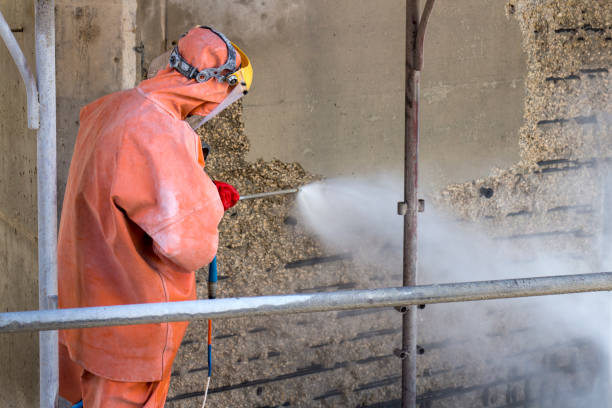
Lime is generally more suitable for environmental areas than for direct application around animals.
3.1 Empty livestock housing
Between production cycles, lime may be considered for:
- Cleaned floors;
- Floor edges;
- Corners;
- Areas under feeders and drinkers;
- Selected wall bases;
- Cleaned drainage surroundings;
- Housing entrances;
- Pathways.
The building should remain empty until:
- Dust has settled;
- The surface has stabilized;
- Ventilation is complete;
- There is no excessive loose lime;
- The area is safe for animals to enter.
3.2 Pathways and corridors
Pathways may carry contamination between:
- Housing rows;
- Loading areas;
- Feed-storage zones;
- Waste areas;
- Farm entrances;
- Vehicle routes.
Lime may support environmental management on cleaned and relatively dry pathways.
It should not be used as a substitute for:
- Cleaning footwear;
- Functional footbaths;
- Vehicle washing;
- Controlled farm entry.
3.3 Areas around livestock housing
Suitable external areas may include:
- Zones immediately outside housing;
- Fence lines;
- Access roads;
- Waste-collection surroundings;
- Parking areas;
- Damp ground after drainage;
- Areas around feed storage;
- Locations frequently used by people and vehicles.
The farm should consider runoff and environmental impacts before repeated use.
3.4 Drainage surroundings
After manure, sludge, and standing water have been removed, lime may be applied in a controlled amount around selected drainage areas.
It should not be poured in large quantities into drains because this may:
- Create sediment;
- Restrict water flow;
- Affect wastewater treatment;
- Increase environmental alkalinity;
- Create additional handling problems.
3.5 Damp zones
Lime may help dry selected damp surfaces after the source of moisture has been corrected.
The farm should first investigate:
- Water leaks;
- Poor drainage;
- Rain entry;
- High stocking density;
- Insufficient ventilation;
- Damaged drinkers;
- Wash-water accumulation.
Adding lime repeatedly without solving the cause of dampness is not an effective long-term measure.
4. Areas Where Lime Requires Extra Caution
4.1 Occupied housing
Applying dry lime where animals are present can create airborne dust.
Direct exposure may affect:
- Eyes;
- Respiratory tract;
- Skin;
- Feet;
- Mucous membranes.
Risk may be higher in:
- Young poultry;
- Piglets;
- Newly transported animals;
- Stressed animals;
- Animals with respiratory problems;
- Poorly ventilated housing.
During production, lime use should generally be prioritized in external areas without direct animal contact.
4.2 Feeders and drinkers
Dry lime should not contaminate feed or drinking water.
If lime is used around these areas:
- Remove feed;
- Protect the equipment;
- Prevent dust entry;
- Clean the equipment before use;
- Confirm that no loose lime remains where animals can ingest it.
4.3 Standing water
Quicklime should not be poured directly into puddles or wet depressions.
This can:
- Generate heat;
- Cause splashing;
- Increase irritation risk;
- Produce uneven treatment;
- Wash the material away;
- Fail to solve the drainage problem.
The correct sequence is:
- Stop the water source;
- Drain the area;
- Remove mud and waste;
- Allow the surface to become relatively dry;
- Apply lime only when appropriate.
4.4 Windy or poorly ventilated conditions
Dry lime can become airborne.
Application should be postponed or carefully controlled when:
- Strong wind is present;
- Dust may enter occupied housing;
- Workers cannot avoid inhalation;
- Ventilation carries powder toward animals;
- Nearby feed or water may become contaminated.
5. Preparation Before Lime Application
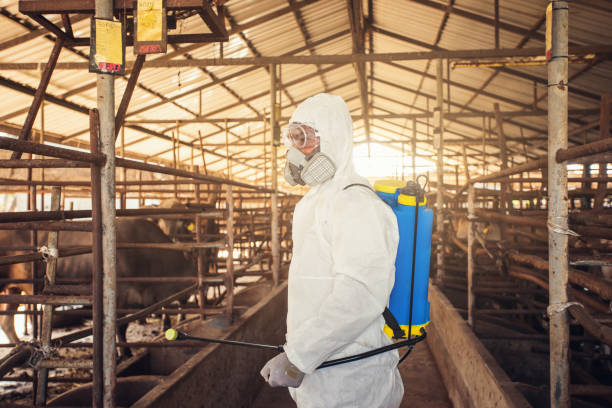
Preparation is essential because lime needs contact with the treated surface.
Step 1: Remove animals when required
For internal housing treatment, the safest approach is generally to work when the housing is empty.
Confirm that:
- Animals have been moved;
- Feed has been removed or protected;
- Drinkers are isolated;
- Workers understand the restricted area.
Step 2: Remove loose material
Remove:
- Manure;
- Old bedding;
- Feed residues;
- Feathers;
- Dust;
- Mud;
- Waste;
- Dead insects;
- Other organic matter.
Step 3: Scrape high-risk points
Pay special attention to:
- Corners;
- Cracks;
- Wall-floor junctions;
- Areas under feeders;
- Areas under drinkers;
- Drain edges;
- Column bases;
- Loading areas;
- Hidden zones behind equipment.
Step 4: Wash where appropriate
Washing may be used to remove remaining dirt where the facility and drainage system allow.
Do not leave wash water or slurry in the treatment area.
Step 5: Drain and dry
The surface should be allowed to drain and become relatively dry.
This is especially important when quicklime is being considered.
Step 6: Inspect the surface
Before application, check:
- Whether manure remains;
- Whether standing water remains;
- Whether drainage is functioning;
- Whether the surface is suitable;
- Whether animals can access the area;
- Whether the selected lime type is appropriate.
6. How to Apply Lime on Different Surfaces
6.1 Concrete floors
For cleaned concrete floors:
- Spread a thin, even layer;
- Avoid piles;
- Treat edges and cracks;
- Limit dust;
- Keep workers and animals away during application;
- Remove excessive loose material before restocking if needed.
Concrete floors may appear dry while cracks remain wet. These areas should be checked before application.
6.2 Soil floors
Soil floors may contain:
- Organic material;
- Moisture;
- Uneven surfaces;
- Deep contamination.
Before applying lime:
- Remove heavily contaminated top material where possible;
- Correct drainage;
- Break up compacted waste layers;
- Allow the surface to dry.
Lime should still be distributed evenly rather than concentrated in a few visible spots.
6.3 Pathways
For pathways:
- Sweep or scrape manure and mud;
- Remove standing water;
- Allow the surface to dry;
- Spread lime evenly;
- Prevent immediate heavy traffic if it would disperse the material.
External lime treatment should not replace vehicle and footwear hygiene.
6.4 Housing entrances
Entrances are high-traffic areas that can accumulate:
- Mud;
- Manure;
- Feed;
- Water;
- Contamination from footwear and wheels.
Clean the entrance before lime application.
A pile of lime at the doorway is not equivalent to a properly maintained access-control system.
6.5 Wall bases and vertical surfaces
Dry powder is difficult to apply safely and evenly on vertical surfaces.
Where suitable, a prepared limewash may be brushed onto:
- Low walls;
- Column bases;
- Floor edges;
- Cement partitions.
Workers should not prepare quicklime mixtures without the correct safety procedure.
6.6 Drainage channels
Before treatment:
- Remove sludge;
- Clear blockages;
- Drain water;
- Clean the channel;
- Confirm that lime will not interfere with wastewater flow.
Use only a controlled amount where appropriate.
7. A Practical Empty-Housing Lime Application Procedure
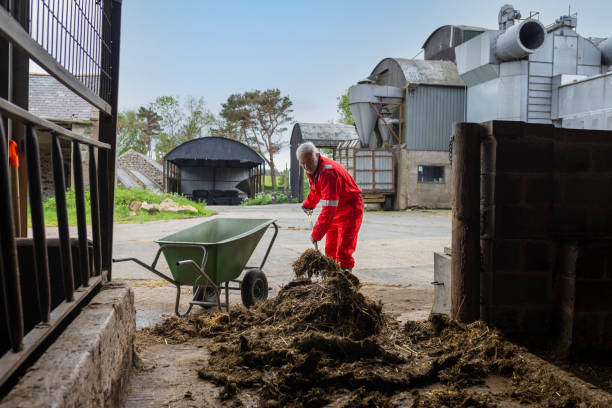
The following workflow may be adapted to the farm’s operating conditions.
Stage 1: Remove the previous herd or flock
Confirm that:
- All animals have left;
- Sick or dead animals are handled separately;
- Feed and portable equipment are removed;
- The building is closed to unauthorized entry.
Stage 2: Remove manure and bedding
Collect:
- Bedding;
- Manure;
- Feed residues;
- Dust;
- Feathers;
- Organic waste.
Waste should be moved to the designated treatment or storage area.
Stage 3: Clean the housing
Clean:
- Floors;
- Walls;
- Equipment;
- Corners;
- Drains;
- Feeders;
- Drinkers;
- Tools;
- Loading areas.
Stage 4: Correct moisture problems
Check:
- Leaking drinkers;
- Broken water lines;
- Roof leaks;
- Drainage;
- Rain entry;
- Poor ventilation.
Do not rely on lime to absorb moisture from an unresolved leak.
Stage 5: Allow the surface to dry
The surface should be relatively dry before lime is spread.
Stage 6: Apply lime
Use:
- A suitable tool;
- Protective equipment;
- A controlled, even spreading method.
Avoid:
- Throwing powder into the air;
- Piling lime;
- Applying near unprotected feed or water;
- Walking through the treated zone unnecessarily.
Stage 7: Treat external high-risk areas
Consider:
- Pathways;
- Entrances;
- Drain surroundings;
- Waste-area surroundings;
- Areas under previous leaks;
- External loading points.
Stage 8: Restrict access
Post a warning and keep unauthorized personnel and animals away.
Stage 9: Ventilate and inspect
Before restocking:
- Ventilate the building;
- Confirm that dust has settled;
- Check for excessive loose lime;
- Inspect feeders and drinkers;
- Confirm that the floor is safe;
- Remove accumulations if needed.
Stage 10: Record the treatment
The record may include:
- Date;
- Lime product;
- Type of lime;
- Supplier or batch;
- Area treated;
- Person responsible;
- Housing status;
- Observed moisture;
- Restocking approval.
8. Timing of Lime Use
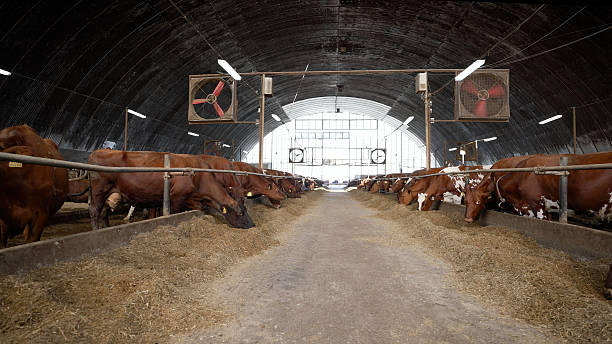
8.1 After animals are removed
This is one of the most appropriate periods for internal lime treatment because:
- Housing can be cleaned thoroughly;
- Animals are not exposed;
- Hidden areas are accessible;
- Ventilation can be completed;
- The farm can inspect the final surface before restocking.
8.2 Before a new herd or flock arrives
Lime may be part of the final housing-preparation program after:
- Cleaning;
- Repair;
- Drainage correction;
- Drying;
- Specialized disinfection where required.
The farm should not apply lime immediately before animals enter without enough time for dust control and inspection.
8.3 After heavy cleaning
Following wash-down and drainage, lime may be considered for selected areas once they are relatively dry.
It should not be applied while floors are still flooded.
8.4 During wet seasons
Rainy periods can increase the frequency of:
- Wet pathways;
- Mud around housing;
- Drain overflow;
- Damp waste areas;
- Water entry.
Lime may support targeted environmental treatment, but the farm should first correct:
- Drainage;
- Roof leaks;
- Water-system problems;
- Poor airflow;
- Soil grading.
8.5 During the production cycle
Internal application should be minimized where animals are present.
Priority may instead be given to:
- External corridors;
- Farm access roads;
- Areas outside housing;
- Waste surroundings;
- Cleaned zones not accessed by animals.
There is no universal weekly or monthly schedule suitable for all farms.
Frequency should depend on:
- Moisture;
- Rainfall;
- Animal species;
- Housing design;
- Stocking density;
- Traffic;
- Waste load;
- Disease risk;
- Farm procedure.
9. How Thick Should the Lime Layer Be?
A precise application rate should come from the product instructions, farm procedure, or professional guidance.
As a general operating principle, lime should be applied in a thin and even layer, not in piles.
An excessively thick layer may:
- Increase dust;
- Irritate workers and animals;
- Waste material;
- Become slippery when wet;
- Create direct contact with feet and skin;
- Interfere with cleaning;
- Accumulate in drains.
More lime does not automatically mean better pathogen control.
10. Worker Protection
Lime is alkaline and can cause irritation or chemical injury.
Personal protective equipment
Depending on the product and application method, workers may need:
- Protective gloves;
- Safety goggles;
- Face protection;
- Dust mask or appropriate respiratory protection;
- Long-sleeved work clothing;
- Rubber boots.
Safe handling practices
Workers should:
- Avoid throwing lime from height;
- Work in a way that minimizes dust;
- Avoid touching the face;
- Keep lime away from food and drinking water;
- Wash exposed skin after use;
- Clean protective equipment;
- Change contaminated clothing.
Exposure response
If lime contacts the eyes or skin:
- Follow the product’s first-aid instructions;
- Rinse with clean water as directed;
- Remove contaminated clothing;
- Seek medical attention when irritation, pain, breathing difficulty, or other symptoms continue.
11. Animal Safety Before Restocking
There is no single waiting period that applies to every housing situation.
Restocking decisions depend on:
- Lime type;
- Quantity used;
- Surface moisture;
- Housing ventilation;
- Animal species;
- Age;
- Direct-contact risk;
- Farm procedure.
Before animals return, confirm that:
- The building is well ventilated;
- No lime dust is visibly suspended in the air;
- There are no thick piles;
- Feeders and drinkers are clean;
- Loose material will not contaminate feed or water;
- Floors are stable and safe;
- Young animals will not directly contact excessive powder.
Extra caution is needed for:
- Chicks;
- Young poultry;
- Piglets;
- Newly transported animals;
- Animals with respiratory disease;
- Poorly ventilated facilities.
12. Lime, Footbaths, and Vehicle-Control Points
Lime should not automatically replace a liquid disinfectant at farm entrances.
Footbaths
A functional footbath needs:
- A product suitable for the target risk;
- Correct concentration;
- Sufficient depth;
- Removal of mud before entry;
- Regular replacement;
- Protection from rain and dirt.
Dry lime at an entrance does not reliably clean heavily contaminated boots.
Vehicle-control areas
Vehicles should generally be:
- Cleared of manure and mud;
- Washed;
- Allowed to drain;
- Treated with a suitable disinfectant;
- Managed under the farm’s vehicle protocol.
Lime may support treatment of selected ground areas but does not replace washing vehicle wheels, undercarriages, and loading compartments.
13. Lime and Other Disinfectants
Lime should not be mixed arbitrarily with chemical disinfectants.
Its high alkalinity may:
- Change product activity;
- Reduce effectiveness;
- Create unwanted reactions;
- Increase corrosion;
- Damage equipment;
- Increase exposure risk.
Do not mix lime with another product in:
- The same sprayer;
- The same mixing container;
- The same footbath;
- The same vehicle pit;
- The same water system.
When different treatments are used in sequence:
- Complete the first procedure;
- Remove residue when required;
- Clean the equipment;
- Confirm compatibility;
- Follow each label independently.
14. Common Mistakes

Mistake 1: Applying lime over manure
Why it fails: Lime does not properly reach the underlying surface.
Better approach: Remove organic material before application.
Mistake 2: Pouring quicklime into standing water
Why it is risky: Heat may be released, and the product may splash or disperse unevenly.
Better approach: Drain, clean, and dry the area first.
Mistake 3: Applying a thick layer
Why it is ineffective: It creates dust and waste without proportionally increasing control.
Better approach: Spread a thin, even layer.
Mistake 4: Treating only the middle of the floor
Why it fails: High-risk contamination often remains in corners, cracks, entrances, and under equipment.
Better approach: Use a zone-based treatment map.
Mistake 5: Bringing animals back too early
Why it is risky: Animals may contact dust or concentrated alkaline material.
Better approach: Ventilate, inspect, and approve the housing before restocking.
Mistake 6: Using lime around occupied animals
Why it is risky: Airborne dust may irritate animals.
Better approach: Prioritize external areas without direct animal contact.
Mistake 7: Using lime as the only disease-control measure
Why it fails: Lime does not control all pathogens or transmission routes.
Better approach: Integrate it into the full biosecurity program.
Mistake 8: Ignoring external pathways
Why it fails: Pathogens may be carried back into cleaned housing.
Better approach: Include entrances, routes, equipment, and waste areas.
Mistake 9: Repeatedly treating a wet zone without repairing it
Why it fails: The source of moisture remains.
Better approach: Repair leaks and drainage first.
Mistake 10: Using unlabelled lime
Why it is risky: Workers do not know whether the product is quicklime, hydrated lime, or another powder.
Better approach: Use identified products with safety information.
15. Zone-Based Lime Application Plan
| Farm area | Lime may be considered when | Main caution |
| Empty concrete floor | Surface is cleaned and relatively dry | Avoid excessive dust and thick layers |
| Soil floor | Waste is removed and drainage is improved | Surface contamination may extend below the top layer |
| Internal pathway | Housing is empty or animals cannot contact the area | Prevent dust movement toward animals |
| External pathway | Mud and manure have been removed | Lime does not replace boot or vehicle disinfection |
| Drain surroundings | Drain has been cleaned and water removed | Do not block the drain with excess material |
| Waste-area surroundings | Waste is contained and the surface is cleaned | Do not allow runoff into water sources |
| Wall bases | Limewash or appropriate method is used | Do not prepare quicklime mixtures without safety controls |
| Occupied housing | Only under a specific technical procedure | Avoid direct animal exposure |
| Standing-water area | After drainage and drying | Do not pour quicklime into water |
| Feed and water area | Only when equipment is protected and later cleaned | Prevent contamination |
16. Practical Monitoring After Application
After treatment, the farm should inspect:
- Dust level;
- Surface condition;
- Remaining moisture;
- Lime accumulation;
- Animal-access risk;
- Feed and water protection;
- Drainage;
- Worker compliance.
The program should also review whether the underlying problem improved.
For example:
- Did the damp area remain dry?
- Was the leaking drinker repaired?
- Did mud continue to enter from outside?
- Was the pathway cleaned before lime was reapplied?
- Did animals show eye, skin, foot, or respiratory irritation?
- Did lime enter feeders or drinkers?
- Was waste handled correctly?
17. Record-Keeping Template
| Date | Housing or area | Lime type | Surface condition | Animals present | Person responsible | Restocking approval | Notes |
| … | … | … | … | … | … | … | … |
The record may also include:
- Product name;
- Batch number;
- Supplier;
- Cleaning date;
- Moisture issue;
- Corrective action;
- Photos;
- Follow-up inspection.
18. Pre-Application Checklist
Product
- Lime type has been identified;
- Label is available;
- Product is dry and properly stored;
- Expiry or quality condition has been checked;
- Workers understand the safety risks.
Area
- Animals have been removed where required;
- Feed and water are protected;
- Manure has been removed;
- Bedding has been removed;
- Mud has been removed;
- Standing water has been drained;
- Surface is relatively dry;
- Drainage is functioning.
Application
- Protective equipment is available;
- Wind conditions are acceptable;
- Correct spreading tools are ready;
- Treatment areas have been mapped;
- Lime will be applied evenly;
- Access will be restricted.
After application
- The area will be ventilated;
- Dust will be checked;
- Excessive piles will be removed;
- Feeders and drinkers will be inspected;
- Restocking will be approved by a responsible person;
- Treatment will be recorded.
19. Frequently Asked Questions
Should livestock housing be cleaned before lime is applied?
Yes. Manure, mud, bedding, feed residues, and other organic material should be removed so lime can contact the treated surface.
Can lime be applied while animals are present?
Direct internal application should be approached cautiously because dust can irritate animals. External areas without direct animal contact are generally more suitable during production.
How long should the farm wait before animals return?
There is no universal waiting time. Animals should return only after dust has settled, ventilation is complete, the surface has stabilized, and there is no excessive loose lime that may contact animals or contaminate feed and water.
Can lime completely replace a disinfectant?
No. Lime is a supporting environmental treatment and does not replace specialized products or disease-specific procedures.
Can lime be applied to a wet floor?
The floor should first be drained, cleaned, and allowed to become relatively dry. Quicklime should not be poured directly into standing water.
Can lime be used in poultry houses?
It may be used as part of environmental management, particularly when the house is empty. Direct exposure of young poultry to airborne lime dust should be avoided.
Can lime be used around piglets?
Extra caution is required because piglets may have direct skin, foot, eye, or respiratory exposure. Internal treatment is generally better carried out when the housing is empty.
Does a thicker layer provide better disinfection?
Not necessarily. A thick layer may increase dust, irritation, waste, and direct-contact risk.
Can lime be added to a footbath?
It should not be treated as a default replacement for a properly selected and maintained footbath disinfectant.
Can lime be mixed with chlorine, QACs, or other disinfectants?
Not without explicit technical or manufacturer guidance. Products should normally be used separately.
Is lime effective against every livestock pathogen?
No. Its effect is limited and highly dependent on conditions. Disease-specific control requires appropriate products and veterinary guidance.
Strengthen Livestock Housing Hygiene and Biosecurity at VIETSTOCK 2026
Lime can support environmental hygiene when farms use the correct material, clean surfaces before application, control moisture, minimize dust, and prevent direct exposure of animals. Its role should be integrated with specialized disinfection, waste management, access control, ventilation, water-system management, and livestock-health monitoring.
At VIETSTOCK 2026, livestock producers, farm managers, veterinary professionals, animal-health companies, and equipment suppliers can explore practical solutions for improving housing hygiene and biosecurity.
Visitors can:
- Explore equipment for cleaning floors, drainage areas, housing surfaces, tools, and livestock vehicles.
- Compare disinfectant products for empty housing, occupied areas, pathways, and access-control points.
- Discover ventilation, humidity-control, drainage, and waste-treatment solutions.
- Connect with animal-health companies, cleaning-equipment suppliers, and biosecurity specialists.
- Discuss how to combine lime treatment with broader cleaning, disinfection, and disease-control procedures.
Expected to feature more than 300 brands, over 10,000 sqm of exhibition space, and 13,000 trade visitors from more than 40 countries and territories, VIETSTOCK 2026 creates opportunities for farms and businesses to compare technologies and strengthen connections across the livestock and animal-health value chain.
Alongside the exhibition and business-networking activities, VIETSTOCK 2026 will also organize an On-Farm Seminar Series, bringing practical knowledge on herd and flock management, disease prevention, biosecurity, and livestock-production efficiency to key livestock regions.
Date: 21–23 October 2026
Venue: Saigon Exhibition and Convention Center – SECC, 799 Nguyen Van Linh Street, Tan My Ward, Ho Chi Minh City, Vietnam
Event website: https://www.vietstock.org/en/
👉 Register to visit VIETSTOCK 2026 and explore livestock-housing cleaning, moisture-control, waste-treatment, and biosecurity solutions:
https://www.vietstock.org/en/online-registration-2/
👉 Learn more about the VIETSTOCK 2026 On-Farm Seminar Series:
https://www.vietstock.org/en/event-features/vietstock-2026-livestock-roadshows-bringing-industry-knowledge-to-key-livestock-regions/
CONTACT INFORMATION:
Exhibiting: Ms. Sophie Nguyen – [email protected]
Visitor Support: Ms. Phuong – [email protected]
Marcom Support: Ms. Anita Pham – [email protected]