Hypothermia in Pigs: Signs, Causes, and Initial Management
Hypothermia in pigs occurs when the body loses heat faster than it can generate and retain enough heat to maintain normal physiological functions. The condition is particularly dangerous in newborn piglets because they are wet at birth, have limited insulation, low energy reserves, and immature thermoregulatory capacity.
The greatest risk occurs immediately after birth and during the first few hours of life. Low-birth-weight piglets, piglets that are slow to reach the udder, or those that do not receive enough colostrum are at greater risk because hypothermia and energy deficiency can create a vicious cycle: the colder the piglet becomes, the weaker it becomes and the less effectively it suckles, while reduced milk intake further limits its ability to produce heat.
Effective management therefore involves more than simply “turning on a heat lamp.” It requires a combination of drying the piglet, providing an appropriate microclimate, assessing its reflexes, supporting timely colostrum intake, and identifying animals that require professional intervention.
When a piglet is cold: what should be prioritised?
- Move the piglet away from the cold area and dry it
Newborn piglets lose heat rapidly when they remain wet, lie on a cold surface, or are exposed to direct draughts. Drying the piglet and moving it to a warm area should be among the first priorities. - Assess whether the piglet is alert and able to swallow
Observe its ability to stand, search for the udder, suckle, swallow, and breathe normally. Rectal temperature provides a more objective assessment than relying only on how cold the ears or skin feel. - Support suckling only when the piglet is sufficiently alert
Once the piglet is warmer, has a swallowing reflex, and is breathing relatively normally, it should be helped to access colostrum. Do not force milk or other fluids into the mouth of a piglet that lacks a swallowing reflex because of the risk of aspiration. - Do not focus only on the individual piglet — check the entire farrowing area
If several piglets are cold or weak, assess the heat source, wet flooring, draughts, colostrum access, and sow health. The heating area should create a separate microclimate for piglets rather than overheating the entire farrowing room. - Severe signs require early professional assessment
Piglets that are motionless, unable to stand, breathing abnormally, lacking a swallowing reflex, having seizures, or continuing to deteriorate despite warming should not simply be left under observation.
1. What is hypothermia in pigs?
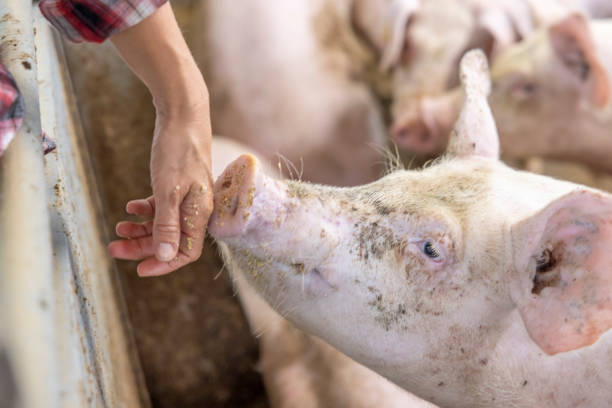
Hypothermia occurs when body temperature falls below the level required to maintain normal physiological functions.
Rectal temperature in healthy pigs is commonly around 38.7–39.8°C, although actual values may vary according to:
- Age.
- Activity.
- Environmental temperature.
- Stress.
- Health status.
In newborn piglets, body temperature may fall substantially within a short period after birth.
This occurs because newborn piglets:
- Are wet at birth.
- Have a large surface-area-to-body-mass ratio.
- Have relatively little subcutaneous fat.
- Have limited energy reserves.
- Are less able than older pigs to maintain body temperature.
The deeper and more prolonged the fall in body temperature, the greater the risk of weakness, poor suckling, hypoglycaemia, and death.
However, severity should not be judged from a single temperature value alone.
Assessment should also include:
- Rectal temperature.
- Level of alertness.
- Ability to stand and move.
- Udder-seeking behaviour.
- Suckling and swallowing reflexes.
- Respiratory pattern.
A rectal temperature around 35°C or below, particularly when accompanied by reduced reflexes or marked weakness, is concerning and warrants more urgent intervention.
2. Why are newborn piglets particularly vulnerable to cold?
Rapid heat loss after birth
Immediately after birth, fluid on the piglet’s skin evaporates and removes heat from the body.
Heat loss may increase further if the piglet lies on:
- Cold flooring.
- Wet flooring.
- Concrete surfaces.
- Areas exposed to direct draughts.
Limited ability to generate heat
Newborn piglets have limited energy reserves and thermoregulatory capacity compared with older pigs.
They therefore depend heavily on:
- Environmental temperature.
- Supplemental heat.
- Lying-surface conditions.
- Colostrum intake.
Low-birth-weight piglets are at greater risk
Small piglets commonly:
- Have lower energy reserves.
- Lose heat more quickly.
- Compete less successfully for teats.
- Are more easily displaced from the udder.
- Become weak more quickly after chilling.
These piglets should be identified and monitored closely from soon after birth.
Piglets born later in the litter
Piglets born toward the end of farrowing may:
- Receive assistance later.
- Reach colostrum later.
- Have a greater risk of weakness if farrowing is prolonged.
Monitoring the farrowing process can therefore play an important role in preventing hypothermia.
3. Colostrum and the hypothermia–energy deficit cycle
Colostrum has two particularly important functions.
First, it provides passive immunity.
Second, it provides energy that helps the piglet maintain heat production.
When a piglet becomes cold:
- Activity decreases.
- Udder-seeking behaviour weakens.
- Suckling ability declines.
- Energy intake falls.
- Heat production declines further.
This creates a cycle:
Hypothermia → weakness → poor suckling → energy deficit → further cooling.
Newborn care should therefore combine:
- Drying.
- Warming.
- Assistance in reaching the udder.
- Monitoring actual suckling.
Environmental temperature alone should not be the focus if the piglet is not actually receiving colostrum.
4. Signs of hypothermia in piglets
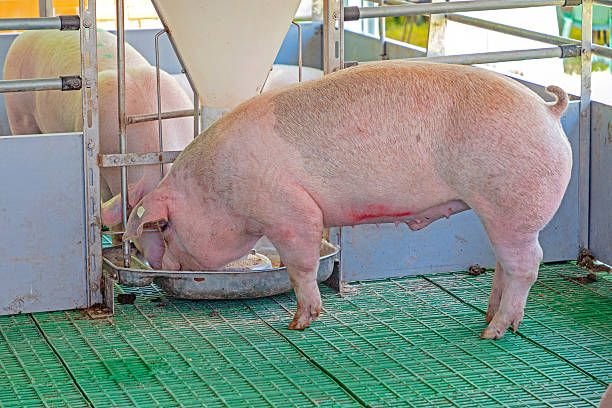
Relatively mild signs
A piglet may:
- Shiver.
- Huddle with littermates.
- Seek the heat source.
- Lie curled up.
- Have colder ears and feet.
- Move less than normal.
If the piglet remains:
- Alert.
- Able to move voluntarily.
- Able to search for the udder.
- Able to suckle.
the condition may not yet be severe.
As hypothermia progresses
Signs may include:
- Weak suckling.
- Difficulty maintaining attachment to a teat.
- Slow movement.
- Spending long periods lying down.
- Failure to seek the heat source.
- Slow response to touch.
- Clearly cold skin and extremities.
Severe signs
Particular concern is warranted when a piglet:
- Lies motionless.
- Cannot stand.
- Does not search for the udder.
- Loses the suckling reflex.
- Loses the swallowing reflex.
- Breathes very weakly or abnormally.
- Has periods of apnoea.
- Responds abnormally or minimally to stimulation.
Seizures are also an emergency sign but are not specific to hypothermia.
They may be associated with:
- Hypoglycaemia.
- Hypoxia.
- Infection.
- Neurological disorders.
- Other serious conditions.
These piglets require early professional assessment.
5. Common causes and risk factors
Cold weather
Risk increases during:
- Severe cold spells.
- Cold rain.
- Strong winds.
- Rapid drops in temperature.
In Vietnam, the risk is generally more apparent during cold periods in northern and central regions.
However, hypothermia can still occur in warmer climates when:
- Newborn piglets remain wet.
- The farrowing area is draughty.
- Rainy conditions persist.
- Flooring is cold or damp.
- The heating system fails.
Direct draughts
Air movement can accelerate heat loss considerably.
Check:
- Doors.
- Gaps in walls.
- Fans.
- Airflow direction.
- Open areas near the farrowing pen.
The creep area should be protected from direct draughts while still maintaining adequate ventilation.
Wet or cold flooring
Cold flooring increases conductive heat loss.
Even with a heat lamp overhead, piglets may remain cold if the lying surface is:
- Wet.
- Cold.
- Poorly insulated.
Lack of a separate creep area
Sows and piglets have very different thermal requirements.
If the entire room is kept warm enough for newborn piglets, the sow may experience:
- Heat stress.
- Reduced feed intake.
- Discomfort.
A more appropriate approach is therefore to create a separate warm microclimate or creep area for the piglets.
Inadequate colostrum or milk intake
Risk increases when:
- The sow produces little milk.
- Piglets cannot locate or access teats.
- Litter size is large.
- Competition for teats is intense.
- Piglets are very small or weak.
Underlying disease
Piglets affected by:
- Diarrhoea.
- Pneumonia.
- Infection.
- Severe weakness or wasting.
may lose the ability to regulate body temperature effectively.
In older pigs, abnormally low body temperature may accompany severe conditions such as:
- Shock.
- Blood loss.
- Severe debilitation.
In these situations, warming is supportive only; the underlying cause still requires treatment.
6. Creep-area temperature and microclimate design
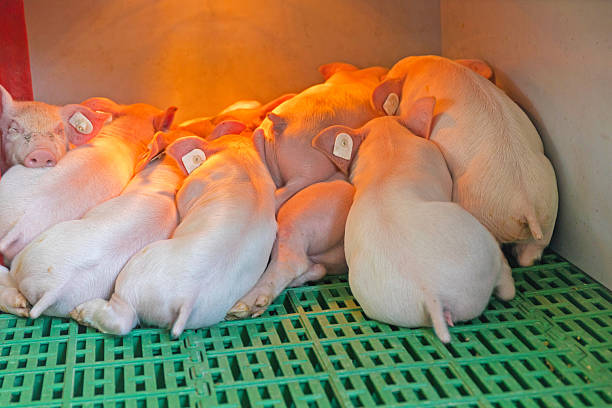
Newborn piglets require a much warmer environment than the sow.
A separate heated area for newborn piglets is often designed around approximately 32–35°C, but this should be treated as a practical reference range rather than a universal target.
Actual thermal requirements depend on:
- Age.
- Body weight.
- Type of heat source.
- Room temperature.
- Flooring.
- Humidity.
- Air movement.
- Creep-area design.
A fixed weekly temperature table should not automatically be applied to every farm.
Thermal requirements generally decline as piglets grow, but adjustments should also be guided by piglet behaviour.
Piglets huddling tightly under the heat source
This may indicate that they are cold.
Check:
- Temperature.
- Draughts.
- Heat-source output.
- Lying-surface temperature.
Piglets lying relatively evenly throughout the creep area
This often suggests that the local environment is relatively comfortable.
Piglets avoiding the heated area
This may suggest:
- Excessive heat.
- Excessively high surface temperature.
- Poor heat-source positioning.
- Uncomfortable airflow.
Air temperature alone should not be the only parameter considered.
For heated mats or heat lamps, also consider:
- Surface temperature.
- Heat distribution.
- Where piglets choose to lie.
7. Initial management of a hypothermic piglet
Step 1: Remove the piglet from the cold environment
Move the piglet to an area that is:
- Dry.
- Warm.
- Protected from direct draughts.
- At low risk of being crushed by the sow.
Weak piglets should receive closer individual monitoring, particularly where competition from stronger littermates is a concern.
Step 2: Dry the piglet
If the piglet is still wet, dry it using:
- A clean towel.
- Another suitable soft, dry material.
Drying is one of the simplest but most important interventions immediately after birth.
Piglets should not simply be left to dry naturally in a cold environment.
Step 3: Warm the piglet in a controlled manner
Suitable options may include:
- A creep area.
- Heat lamp.
- Heating pad.
- An appropriately warmed lying surface.
Avoid:
- Placing the piglet too close to a heat lamp.
- Placing it directly on an excessively hot surface.
- Covering the piglet so tightly that ventilation is restricted.
- Applying uncontrolled excessive heat.
The goal is to return the piglet to an appropriate thermal environment without causing burns or overheating.
Step 4: Assess reflexes
Monitor:
- Alertness.
- Breathing.
- Movement.
- Ability to stand.
- Udder-seeking reflex.
- Swallowing reflex.
Step 5: Support suckling when the piglet is alert enough
Once the piglet:
- Moves more effectively.
- Becomes more alert.
- Has a swallowing reflex.
it can be helped to access the sow’s udder.
Place the piglet at a teat and confirm that it is actually suckling.
Do not simply place the piglet beside the sow and assume that adequate colostrum intake has occurred.
8. Do not force fluids when the swallowing reflex is absent
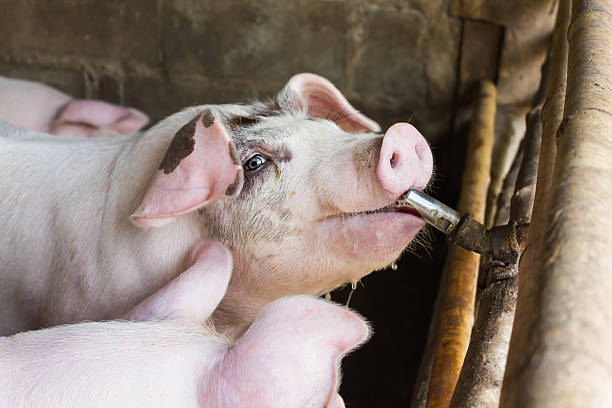
If a piglet is:
- Motionless.
- Extremely lethargic.
- Unable to swallow.
- Breathing weakly.
do not force milk, water, or other fluids into its mouth.
Fluid may enter the respiratory tract and cause aspiration.
Techniques such as stomach-tube feeding should also not be performed by untrained personnel.
When the swallowing reflex is absent or the piglet is severely weak, priorities include:
- Maintaining warmth.
- Keeping the airway clear.
- Monitoring breathing.
- Contacting a veterinarian or appropriately trained technician.
9. When should a veterinarian be contacted?
There is no need to wait a fixed “30–60 minutes” when severe signs are already present.
Professional assistance should be sought promptly if the piglet:
- Is motionless.
- Is unresponsive.
- Has no swallowing reflex.
- Cannot suckle.
- Breathes very weakly.
- Has abnormal breathing.
- Experiences periods of apnoea.
- Has seizures.
- Cannot stand.
- Has a markedly reduced body temperature.
- Continues to deteriorate despite being moved into an appropriate environment.
An underlying disease should also be considered when the piglet has:
- Diarrhoea.
- Respiratory difficulty.
- Abdominal abnormalities.
- Navel inflammation.
- Signs of infection.
- Several littermates becoming weak at the same time.
Hypothermia may be a consequence of another problem rather than the only disorder present.
10. Preventing hypothermia from birth
Monitor the farrowing process
Where farm conditions allow, increased supervision around farrowing can help identify:
- Weak newborn piglets.
- Low-birth-weight piglets.
- Piglets that become trapped or experience difficulty during birth.
- Piglets born late in the litter.
- Piglets lying away from the heat source.
Dry piglets immediately after birth
Drying reduces evaporative heat loss.
This should be among the first priorities, particularly when:
- Room temperature is low.
- Draughts are present.
- Piglets have low birth weight.
Move piglets into the warm zone
After drying, place piglets in the appropriate heated area.
However, they must still have sufficient opportunity to access the sow and consume colostrum.
Help weak piglets reach the udder
Particular attention should be given to:
- The smallest piglets in the litter.
- Piglets born late.
- Piglets that are slow to become active.
- Piglets that are losing competition for teats.
Monitor after suckling
Observation should not stop after the piglet has been placed at the udder once.
Confirm that the piglet:
- Successfully suckles.
- Becomes progressively warmer.
- Shows improving reflexes.
- Is not displaced from the lying area.
- Is not lying alone in a cold location.
11. Balancing piglet warmth, ventilation, and sow comfort
A farrowing environment that is too cold increases the risk of piglet hypothermia.
However, excessive room temperature may create heat stress for the sow.
A more appropriate strategy is:
Maintain the farrowing room at a temperature suitable for the sow while providing a separate warm microclimate for the piglets.
The entire farrowing room should not be heated to the temperature required in the piglet creep area.
In addition to temperature, the farrowing environment still requires:
- Adequate ventilation.
- Humidity control.
- Ammonia reduction.
- Dry flooring.
- Protection from direct draughts affecting piglets.
An overly enclosed farrowing room may increase:
- Humidity.
- Harmful gas accumulation.
- Respiratory-disease risk.
The objective is therefore adequate ventilation without creating a direct draught across the piglet area.
12. Common mistakes when warming piglets
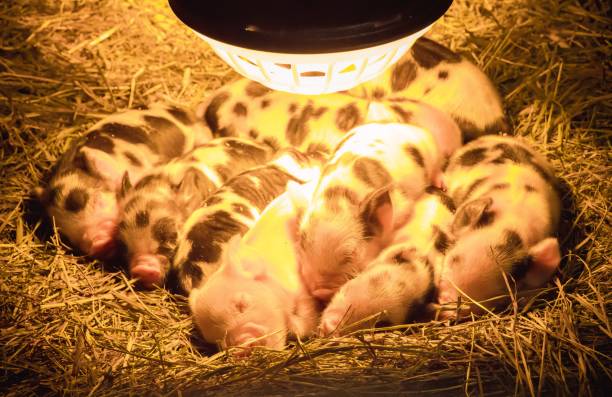
Excessive heating
An excessively powerful heat source may cause:
- Burns.
- Heat stress.
- Avoidance of the creep area.
If the heated area is too warm, piglets may move closer to the sow, potentially increasing the risk of crushing.
The heated zone should provide:
- Adequate space.
- Relatively even heat distribution.
- Allowing piglets to choose a comfortable position.
Using a heat lamp while leaving the floor wet
A heat lamp cannot fully compensate for heat loss if piglets continue to lie on cold or wet flooring.
Management should also include:
- Drying the lying area.
- Correcting water leaks or excess moisture.
- Improving insulation where necessary.
- Adjusting the heat source.
An overcrowded creep area
A creep area that is too small may:
- Increase crowding.
- Produce uneven heat distribution.
- Prevent weak piglets from accessing suitable lying positions.
The creep area should be appropriately sized for the number of piglets and the farrowing-pen design.
Assessing temperature only by touching the ears
Cold ears or feet may suggest heat loss, but they do not accurately reflect core body temperature.
Where possible, rectal temperature should be used for a more objective assessment.
Giving medication automatically
Hypothermia does not automatically require:
- Antibiotics.
- Injectable vitamins.
- Fluid therapy.
- Stimulants.
Medication should only be used where there is:
- An appropriate diagnosis.
- An underlying condition requiring treatment.
- Professional guidance.
13. Checklist for managing and preventing hypothermia in piglets
When a piglet is cold or weak
- Identify the affected piglet.
- Remove it from the cold area.
- Check whether the body is wet.
- Dry the piglet.
- Move it to a warm area.
- Measure rectal temperature where feasible.
- Assess alertness.
- Assess breathing.
- Assess the suckling reflex.
- Assess the swallowing reflex.
When reflexes begin to recover
- Help the piglet reach a teat.
- Confirm that it actually suckles.
- Keep the lying area dry.
- Continue monitoring body temperature.
- Monitor the ability to stand.
- Monitor alertness.
Contact a veterinarian or trained technician when
- The piglet is motionless.
- The swallowing reflex is absent.
- The piglet cannot suckle.
- Breathing is weak or abnormal.
- Seizures occur.
- The piglet cannot stand.
- The piglet does not respond to initial supportive measures.
- Signs of an underlying disease are present.
Before farrowing
- Check the heat source.
- Check heating pads and the creep area.
- Check for draughts.
- Keep the lying area dry.
- Prepare drying materials.
- Ensure that the creep area has sufficient space.
Immediately after birth
- Dry the piglet.
- Move it to the warm area.
- Identify low-birth-weight piglets.
- Support access to colostrum.
- Monitor piglets born later in the litter.
- Check the risk of crushing by the sow.
14. Frequently asked questions about hypothermia in piglets
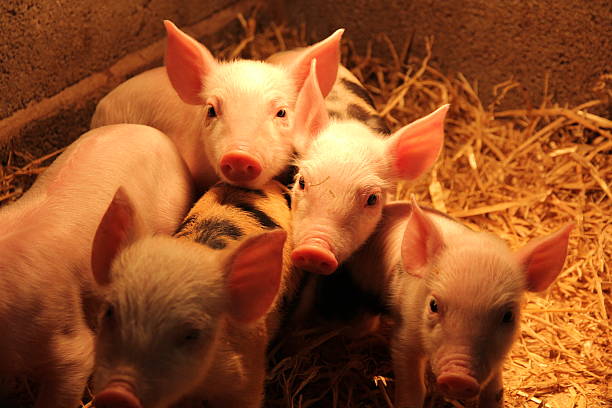
Do shivering and huddling always mean that a piglet has hypothermia?
No.
Shivering and huddling may indicate a response to a cold environment without necessarily meaning that severe hypothermia is already present.
Also check:
- Is the piglet moving?
- Is it suckling?
- Is it responding normally?
- What is the rectal temperature?
- Are other signs of disease present?
Is a thermometer necessary?
A thermometer is useful where available.
Rectal temperature helps:
- Provide a more objective assessment.
- Monitor response to warming.
- Distinguish cold-feeling skin from actual core-body hypothermia.
However, if the piglet is motionless or breathing very weakly, warming should not be delayed simply while waiting to obtain a temperature reading.
What temperature is suitable for the creep area?
For newborn piglets, a separate heated area is often maintained at approximately 32–35°C.
This should not be treated as a fixed value for every farm.
Adjustment should consider:
- Age.
- Body weight.
- Flooring.
- Heat source.
- Humidity.
- Draughts.
- Piglet behaviour.
When are piglets most vulnerable to hypothermia?
Risk is greatest immediately after birth and during the first few hours of life.
The first 24–48 hours still require close observation, particularly for:
- Low-birth-weight piglets.
- Piglets with poor suckling.
- Piglets born late in the litter.
- Piglets with underlying disease.
Should a cold piglet be given milk immediately?
Only when the piglet:
- Is sufficiently alert.
- Can swallow.
- Has relatively stable breathing.
If the swallowing reflex is absent or the piglet is extremely weak, do not force fluids because of aspiration risk.
Should medication be given to a hypothermic piglet?
Medication should not be given solely because a piglet is cold.
If the underlying cause involves:
- Infection.
- Diarrhoea.
- Respiratory disease.
- Severe hypoglycaemia.
- Another systemic disorder.
a veterinarian may select appropriate treatment.
Can hypothermia cause multiple piglets in the same litter to die?
Yes.
Risk increases when the entire litter is exposed to factors such as:
- Heat-source failure.
- A cold farrowing room.
- Direct draughts.
- Wet flooring.
- Failure to dry piglets.
- Low sow milk production.
- Inadequate monitoring during farrowing.
If multiple piglets become weak or die at the same time, the entire production environment should be assessed rather than managing each piglet in isolation.
Optimising the Microclimate and Newborn Piglet Care at VIETSTOCK 2026
Hypothermia in piglets is influenced not only by ambient temperature but also by lying-surface conditions, draughts, colostrum intake, and the health of individual animals. Reducing risk during the first hours after birth should therefore be considered part of an integrated neonatal-care programme, from monitoring farrowing to creep-area design and environmental control.
At VIETSTOCK 2026 – Vietnam’s Premier International Feed, Livestock & Meat Industry Show, pig producers, technicians, and businesses can explore developments in swine production, exchange practical experience, and connect with organisations across the industry. The event is expected to bring together 300 brands, over 10,000 sqm of exhibition area, and 13,000 trade visitors from 40 countries.
For farms looking to improve newborn piglet care from the first hours of life, participants can explore:
- Thermal and microclimate-control equipment: solutions designed to provide an appropriate thermal zone for piglets without increasing heat stress in sows.
- Ventilation and housing environment: technologies that support control of temperature, humidity, airflow, and air quality in farrowing facilities.
- Creep-area equipment and design: solutions for lying areas, heat sources, and newborn piglet management.
- Sow and piglet nutrition: approaches that support sow health, colostrum availability, and piglet adaptation during early life.
- Farm-monitoring technology: systems that support monitoring of the environment, animal behaviour, and abnormal changes that may require early attention.
Participants interested in improving herd health through the wider production system can also learn more at the One Health Forum on 22 October 2026. The programme highlights practical approaches related to nutrition, farm management, biosecurity, and hygiene, supporting a preventive approach in which piglet health is addressed through housing and management conditions rather than only after animals have already become weak.
Date: 21–23 October 2026
Venue: Saigon Exhibition and Convention Center (SECC), 799 Nguyen Van Linh Street, Tan My Ward, Ho Chi Minh City, Vietnam
Event website: https://www.vietstock.org/en/
Register to visit now: https://ers-vn.informa-info.com/vs26
👉 VIETSTOCK 2026 Visitor Registration Information
👉 Learn more about the One Health Forum
Contact information:
Exhibiting: Ms. Sophie Nguyen – [email protected]
Visitor Support: Ms. Phuong – [email protected]
Marcom Support: Ms. Anita Pham – [email protected]